


A Mount Kenya hike takes you onto the slopes of Africa's second-highest mountain, through bamboo forests and moorland dotted with giant plants, past glacial lakes and up to a summit that catches the first light of dawn above the clouds. It is wilder and quieter than Kilimanjaro, with scenery many hikers consider even more beautiful.
This guide explains everything you need to plan a Mount Kenya hike: the peaks, the main routes to Point Lenana, how many days you need, the best time to go, what you will see along the way, how to handle the altitude and what to pack.
In This Guide
- About Mount Kenya
- The Peaks: Batian, Nelion and Point Lenana
- Mount Kenya Hike Routes
- A Sample Mount Kenya Hike Itinerary
- Wildlife and Plants
- Best Time for a Mount Kenya Hike
- Altitude and Safety
- What to Pack
- Plan Your Hike
About Mount Kenya
Mount Kenya is an extinct volcano that rises just south of the equator in central Kenya. The country itself takes its name from the mountain, which the Kikuyu people call Kirinyaga. For many communities living around its base, the mountain has deep spiritual meaning, and traditional homes were once built with their doors facing its peaks.
The mountain and its surrounding forests are protected as Mount Kenya National Park and National Reserve. Together with the nearby Lewa Wildlife Conservancy and Ngare Ndare Forest, they form a UNESCO World Heritage Site, recognised for their spectacular landscapes and unique high-altitude plant life. The national park is managed by the Kenya Wildlife Service, while the lower forests fall under the Kenya Forest Service.
Unlike Kilimanjaro's single snow-capped dome, Mount Kenya has a cluster of jagged rock peaks, surrounded by deep valleys, tarns and small glaciers. This rugged character is what makes a Mount Kenya hike so rewarding for nature lovers and photographers.
The Peaks: Batian, Nelion and Point Lenana
Mount Kenya has three main summits:
- Batian (5,199 metres) is the highest point. Reaching it requires technical rock climbing with ropes and experience.
- Nelion (5,188 metres) is the second-highest peak, separated from Batian by a narrow gap. It is also a technical climb.
- Point Lenana (4,985 metres) is the trekking summit. It can be reached without climbing equipment, and it is the goal of almost every Mount Kenya hike.
The view from Point Lenana at sunrise is extraordinary. On a clear morning you look across the jagged twin peaks of Batian and Nelion, down onto glaciers and tarns, and sometimes all the way to the distant outline of Kilimanjaro.
Mount Kenya Hike Routes
There are several routes up the mountain. Each Mount Kenya hike route has its own character, and many hikers ascend on one route and descend on another to see more of the mountain.
Sirimon Route
The Sirimon Route climbs the north-western side of the mountain, starting near Nanyuki. It is a gradual, well-graded trail that offers good acclimatisation and beautiful scenery, passing through forest and open moorland before following the Mackinder Valley to Shipton's Camp at the base of the main peaks. Sirimon is a popular choice for a first Mount Kenya hike. Our Mt Kenya hike via the Sirimon Route follows this path.
Chogoria Route
Chogoria, on the eastern side, is widely regarded as the most beautiful route on the mountain. It passes the dramatic Gorges Valley, Lake Michaelson and the sparkling Hall Tarns, with cliffs and waterfalls along the way. It is longer than Sirimon and is often used for the descent, creating a superb traverse of the mountain.
Naro Moru Route
The Naro Moru Route on the western side is the most direct and the quickest way to Point Lenana. It includes a notoriously boggy section above the forest, often called the "vertical bog", before climbing the Teleki Valley to Mackinders Camp. Because it gains height quickly, it offers less time for acclimatisation.
Other Routes
Quieter routes such as Burguret, Timau and Kamweti see far fewer hikers. They are best tackled with an experienced guide who knows the terrain well, and they suit trekkers looking for solitude.
Combining Routes
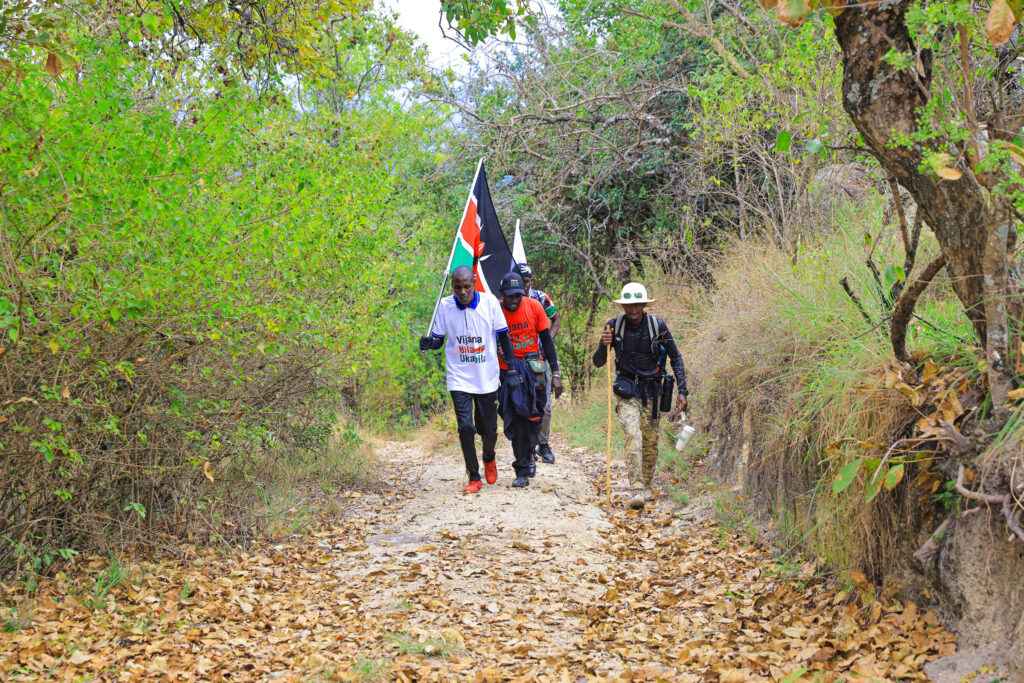
A popular way to plan a Mount Kenya hike is to climb the Sirimon Route and descend via Chogoria. This combination gives a gentle ascent, the summit at Point Lenana and the dramatic eastern scenery on the way down. It usually takes five days.
A Sample Mount Kenya Hike Itinerary
Most hikers take between three and five days to reach Point Lenana and return. More days give better acclimatisation and a more relaxed pace. Here is a typical four-day Mount Kenya hike on the Sirimon Route.
Day 1: Nanyuki to Old Moses Camp
After a drive to the Sirimon Gate and registration with the park, you walk through forest and open grassland to Old Moses Camp at around 3,300 metres. The pace is easy, and you may see monkeys and birds along the way.
Day 2: Old Moses to Shipton's Camp
The trail climbs through moorland into the beautiful Mackinder Valley, lined with giant groundsels and lobelias. You reach Shipton's Camp, at around 4,200 metres, in the afternoon, with the main peaks towering directly above you.
Day 3: Summit Point Lenana and Descend
An early start, usually between 2am and 3am, takes you up steep switchbacks by headlamp. You reach Point Lenana around sunrise, enjoy the view, then descend to a lower camp. This is the longest and most demanding day of the Mount Kenya hike.
Day 4: Descent and Return
The final morning brings an easy walk back down to the gate, followed by a drive to Nanyuki or onward to your next destination.
Adding an extra night at Shipton's Camp, or choosing a five-day Sirimon-Chogoria traverse, is a great way to improve acclimatisation and see more of the mountain.
Wildlife and Plants on a Mount Kenya Hike
One of the joys of a Mount Kenya hike is the way the landscape changes as you climb. Each zone has its own plants and wildlife.
The Forest Zone
The lower slopes are covered in montane forest and bamboo. Elephants and buffalo live here, although they are shy and usually heard rather than seen. Look out for black-and-white colobus monkeys, Sykes' monkeys and bushbuck, and listen for the calls of turacos and hornbills.
The Moorland Zone
Above the forest, the vegetation opens into heath and moorland. This is where the mountain's famous giant plants grow. Giant groundsels, which can reach several metres in height, and giant lobelias with tall flower spikes give the valleys an otherworldly feel.
The Alpine Zone
Higher still, the landscape becomes rocky and bare, with tarns, scree slopes and small glaciers. Rock hyraxes bask on boulders near the camps, and bright sunbirds feed on lobelia flowers. Hikers sometimes spot eland or the tracks of leopards at surprising altitudes.
Retreating Glaciers
Mount Kenya's glaciers have shrunk significantly over the past century. Seeing the remaining ice up close is one of the most memorable and thought-provoking parts of a Mount Kenya hike.
Best Time for a Mount Kenya Hike
A Mount Kenya hike is possible for much of the year, but the dry seasons offer the best conditions:
- January to February is dry and generally clear, making it one of the best periods to hike.
- Late June to September is the other main dry season. Days are usually clear, although nights are very cold at the high camps.
- March to May brings the long rains, with muddy trails, more cloud and snow higher up.
- October to December brings the short rains, especially in November.
Mornings are usually the clearest time of day on the mountain, with clouds often building in the afternoon. That is another reason summit attempts start so early. For more on Kenya's seasons, read our guide to the best time to visit Kenya.
Altitude and Safety on a Mount Kenya Hike
Point Lenana is nearly 5,000 metres high, so altitude is a serious consideration on any Mount Kenya hike. The mountain can be climbed quickly, which is exactly why some hikers develop altitude sickness. Taking your time is the best protection.
- Choose an itinerary of at least four days, ideally five.
- Walk slowly and steadily, especially above 3,500 metres.
- Drink plenty of water and eat regularly.
- Tell your guide if you develop a severe headache, nausea, dizziness or breathlessness at rest.
- Descend if symptoms worsen. Going down is the most effective treatment.
- Speak to your doctor before travelling about altitude medication and any health conditions.
Hiking with a registered, experienced guide is strongly recommended and is usually required by the park. Guides know the trails, can read the weather and are trained to recognise altitude illness. Porters can carry your main bag, letting you focus on the walk.
Fitness for a Mount Kenya Hike
A Mount Kenya hike is not technical, but it is physically demanding. You should be comfortable walking for six to eight hours on uneven ground. Prepare with regular hill walks, stair climbing and longer hikes carrying a daypack in the weeks before you travel. A warm-up hike such as our 1 Day Hike at Mt Longonot is a great test.
What to Pack for a Mount Kenya Hike
Temperatures range from warm in the forest to well below freezing at Point Lenana before dawn, so layering is essential.
- Broken-in waterproof hiking boots
- Thermal base layers and a warm fleece
- An insulated jacket for the summit morning
- Waterproof jacket and trousers
- Warm hat, sun hat, gloves and a buff
- A sleeping bag rated for sub-zero temperatures
- Headlamp with spare batteries
- Trekking poles
- Gaiters for muddy sections
- Water bottles, purification tablets and snacks
- Sunglasses and high-factor sunscreen
- A small personal first-aid kit
Our Kenya safari packing list covers what you will need for the rest of your trip.
Mountain Huts and Camps
Accommodation on the mountain is simple but welcoming after a long day on the trail. The main routes have a mix of basic huts, bandas and campsites, and your operator will arrange either hut beds or tents depending on the route and season.
On the Sirimon side, Old Moses Camp sits at the edge of the moorland, while Shipton's Camp lies at the head of the Mackinder Valley, directly beneath the main peaks. On the Naro Moru side, the Met Station and Mackinders Camp are the usual overnight stops. Chogoria has Mintos Camp near the Hall Tarns, one of the most scenic campsites on the mountain.
Facilities are basic: expect bunk beds or tent pitches, simple toilets and cold nights. Your cook prepares hot meals and drinks, and evenings are spent wrapped up in warm layers, watching the sunset light up the peaks.
Guides, Porters and Park Rules
Walking with a registered mountain guide is the safest way to enjoy the mountain, and in most cases it is required. Guides know the weather patterns, the safest lines up the scree and the early signs of altitude illness. Porters carry the heavier bags, while cooks keep the team well fed.
All hikers must register at the park gate and pay the relevant park and camping fees, which your operator normally arranges. Keep your entry documents with you, follow your guide's instructions and stay on the marked trails, especially in fog, when it is easy to lose the path.
It is customary to tip your mountain crew at the end of the trek. Your operator can explain local practice, so you can thank the team that made the climb possible.
Getting to Mount Kenya
The mountain is around three to four hours by road from Nairobi. Nanyuki, on the north-western side, is the main base for the Sirimon and Naro Moru routes, while the town of Chogoria serves the eastern route. Many hikers spend the night before their trek in Nanyuki, which has comfortable lodges, supermarkets and places to buy last-minute supplies.
Scheduled flights also connect Nairobi with Nanyuki's airstrip, which is convenient if you are combining the trek with a safari in Laikipia or Samburu.
Hiking Responsibly
The high-altitude environment is fragile and recovers slowly from damage. Carry all rubbish back down, use the toilets provided at camps, avoid picking plants and keep a respectful distance from wildlife. Choosing a local operator that pays its crew fairly also helps the communities around the mountain benefit from tourism.
Mount Kenya Hike or Kilimanjaro?
Many trekkers wonder whether to choose a Mount Kenya hike or climb Kilimanjaro. Both are superb, and many people eventually do both.
- Height: Kilimanjaro is higher, and reaching Uhuru Peak means standing on the highest point in Africa. Point Lenana is lower but still a serious high-altitude goal.
- Crowds: A Mount Kenya hike is usually much quieter, with fewer groups on the trail.
- Scenery: Mount Kenya's jagged peaks, valleys and tarns are often considered more varied and dramatic.
- Time: A Mount Kenya hike can be completed in three to five days, compared with five to nine days on Kilimanjaro.
A Mount Kenya hike also makes excellent preparation for Kilimanjaro. Read our full guide to climbing Kilimanjaro to compare the two.
Combine Your Mount Kenya Hike With a Safari
The mountain sits close to some of Kenya's finest wildlife areas, so it is easy to add a safari before or after your Mount Kenya hike.
- Ol Pejeta Conservancy, near Nanyuki, is home to rhinos, chimpanzees and the Big Five. Read our Ol Pejeta Conservancy guide.
- Samburu National Reserve lies a few hours to the north and is famous for its Special Five. See our Samburu National Reserve guide.
- The Masai Mara is perfect for a classic big-cat safari after your trek. Our 5 Day Ol Pejeta, Lake Nakuru and Masai Mara Safari links the north with the Mara.
Common Questions About a Mount Kenya Hike
How long does a Mount Kenya hike take? Most hikes to Point Lenana take three to five days. Four or five days are recommended for better acclimatisation.
Do I need climbing experience? No. Point Lenana is a trekking summit. Only Batian and Nelion require technical climbing skills.
Is a Mount Kenya hike harder than Kilimanjaro? Point Lenana is lower, but some routes gain height quickly. With a sensible itinerary, both are achievable for fit, well-prepared hikers.
How cold does it get near the summit? Before dawn at Point Lenana, temperatures often drop below freezing, and strong winds make it feel colder. Pack an insulated jacket, warm gloves and a hat, and keep your water bottle inside your jacket so it does not freeze.
Where do hikers sleep? Most routes have mountain huts or campsites. Your operator will arrange tents or hut bookings, depending on the route.
Can I see wildlife? Yes. Monkeys, antelopes and rock hyraxes are common, and elephants and buffalo live in the forests lower down.
Plan Your Mount Kenya Hike
A Mount Kenya hike combines adventure, wild scenery and a real sense of achievement. With a good guide and the right preparation, reaching Point Lenana at sunrise is within reach for most fit, determined walkers.
See our Mt Kenya hike via the Sirimon Route, explore all our Kenya safari packages, or contact us to plan your Mount Kenya hike and safari together.