


Lake Manyara National Park is one of the most beautiful and varied parks on Tanzania's northern safari circuit. Squeezed between the dramatic wall of the Great Rift Valley escarpment and a shimmering soda lake, it packs lush groundwater forest, open grasslands, acacia woodland, hot springs and wetlands into a compact area. Ernest Hemingway famously called it "the loveliest I had seen in Africa", and many visitors still agree.
This guide covers everything you need to know about Lake Manyara National Park: its landscapes, famous tree-climbing lions, elephants and baboons, flamingos and birdlife, the best activities, when to visit, how to get there and how it fits into a northern Tanzania safari with Tarangire, Ngorongoro and the Serengeti.
In This Guide
- About Lake Manyara National Park
- 7 Highlights of Lake Manyara National Park
- Wildlife
- Birds and Flamingos
- Things to Do
- Best Time to Visit
- Getting There and Where to Stay
- Combine With the Northern Circuit
- Plan Your Safari
About Lake Manyara National Park
Lake Manyara National Park lies in northern Tanzania, about two hours' drive west of Arusha, at the foot of the Rift Valley escarpment. The park stretches along the western shore of Lake Manyara, a shallow alkaline lake whose size changes with the seasons. A large part of the park is covered by the lake itself, while the land area forms a narrow strip between the water and the steep escarpment wall.
Despite its small size, Lake Manyara National Park contains a remarkable range of habitats. Underground springs seeping from the base of the escarpment feed a dense groundwater forest of tall fig and mahogany trees, which feels more like a jungle than a savannah park. Further south, acacia woodland, open grassland and marshes lead down to the lakeshore, where hot springs bubble up at Maji Moto.
The park is managed by Tanzania National Parks, and the wider area forms part of the Lake Manyara Biosphere Reserve, recognised by UNESCO for its ecological importance.
7 Highlights of Lake Manyara National Park
1. The Groundwater Forest
Entering Lake Manyara National Park, you drive straight into a green, shady forest fed by springs. Giant fig trees, mahoganies and sausage trees tower overhead, and the forest is alive with blue monkeys, baboons and birds. It is a wonderful contrast to the dry plains of many other parks.
2. Tree-Climbing Lions
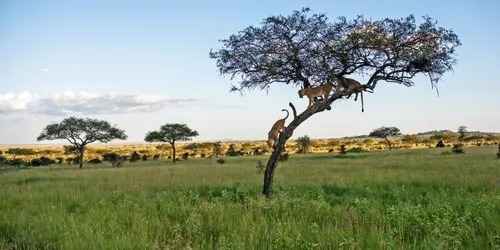
Lake Manyara National Park became famous for its lions' habit of resting in the branches of acacia and mahogany trees. Nobody is completely sure why they do it. Theories include escaping biting insects, catching a cooling breeze or getting a better view of prey. Sightings are less predictable than they once were, but spotting a lion draped along a branch remains a special highlight.
3. Elephants in the Forest
Elephants move between the forest, woodland and lakeshore, and it is common to see family herds feeding among the trees or crossing the road. Watching elephants in this lush forest setting feels very different from seeing them on open plains.
4. Huge Baboon Troops
Lake Manyara National Park is known for its large troops of olive baboons. Watching them groom, play, squabble and care for their young is endlessly entertaining, especially along the forest roads in the morning.
5. Flamingos and the Lake
When conditions are right, the alkaline lake attracts large flocks of flamingos, turning its shallows pink. Pelicans, storks and many other water birds gather along the shore.
6. The Rift Valley Escarpment
The towering escarpment that forms the park's western boundary is one of the most dramatic sections of the Great Rift Valley in Tanzania. The views from the top, looking down over the forest and the lake, are breathtaking.
7. The Hot Springs at Maji Moto
In the south of Lake Manyara National Park, hot springs called Maji Moto, meaning "hot water" in Swahili, rise from the ground near the lakeshore. Steam drifts above the pools, and the surrounding area is good for birdwatching.
Wildlife in Lake Manyara National Park
Although it is small, Lake Manyara National Park supports a rich variety of wildlife:
- Elephants in the forest, woodland and along the lake.
- Lions, including the famous tree-climbers.
- Leopards, shy but present in the forest and woodland.
- Buffalo on the grassy plains near the lake.
- Giraffes, zebras and wildebeest grazing on the open grassland.
- Hippos, best seen at the hippo pool near the northern part of the park.
- Impala, waterbuck, bushbuck and dik-dik in the woodland.
- Blue monkeys and olive baboons in the groundwater forest.
Lake Manyara National Park does not have the vast herds of the Serengeti, but its variety of habitats and close-up encounters in the forest make it a rewarding stop.
Birds and Flamingos
Lake Manyara National Park is a paradise for birdwatchers, with several hundred species recorded. The combination of forest, woodland, grassland, marsh and lake creates an exceptional diversity of birds.
- Water birds: flamingos, great white pelicans, yellow-billed storks, African spoonbills, herons, egrets and cormorants.
- Forest birds: silvery-cheeked hornbills, crowned eagles and many colourful sunbirds and turacos.
- Raptors: African fish eagles, bateleurs and martial eagles.
- Grassland birds: ground hornbills, kori bustards and secretary birds.
Flamingo numbers vary greatly with water levels and food supply. When the lake is suitable, thousands may gather in the shallows. The wet season, from November to April, is especially good for birding, as migrant species arrive from Europe and Asia.
Things to Do in Lake Manyara National Park
- Game drives through the forest, woodland and grassland, usually as a half-day or full-day excursion.
- The treetop walkway, a canopy walkway of suspension bridges through the forest, offering a bird's-eye view of the trees, monkeys and birds.
- Night game drives, which are permitted in Lake Manyara National Park, revealing nocturnal animals such as genets, bushbabies and hunting predators.
- Canoeing on the lake when water levels allow, for close views of birds and hippos from a safe distance.
- Walking safaris along the escarpment and in designated areas with an armed ranger.
- Mountain biking and cultural tours in Mto wa Mbu, the lively village outside the park gate, known for its banana plantations, markets and many ethnic groups.
- Picnics at scenic sites in the forest or by the hippo pool.
Best Time to Visit Lake Manyara National Park
Lake Manyara National Park can be visited all year, and each season has its own appeal:
- June to October (dry season): the best time for large mammals, as animals gather near water and vegetation is thinner. This is also the busiest season on the northern circuit.
- November to April (wet seasons): the best time for birdwatching and green scenery, with migrant birds and waterfalls on the escarpment. Afternoon showers are common.
- March to May: the long rains, with fewer visitors and lush landscapes. Some roads can be muddy.
Our guide to the best time to visit Tanzania explains the seasons across the whole country.
Getting to Lake Manyara National Park and Where to Stay
Getting There
Lake Manyara National Park is about two hours by road from Arusha, on the main route to Ngorongoro and the Serengeti. Most international visitors fly into Kilimanjaro International Airport. A small airstrip near the park also receives scheduled light-aircraft flights.
Where to Stay
Accommodation options include lodges perched on the escarpment with sweeping views over the lake, tented camps in the forest and comfortable guesthouses in and around Mto wa Mbu and Karatu. Many travellers visit Lake Manyara National Park as a half-day or full-day stop on the way to Ngorongoro, staying in Karatu or on the crater rim. Our guide to where to stay in Ngorongoro covers nearby options.
A Short History
The area was declared a national park in 1960, protecting the forest, the lakeshore and the wildlife that depends on them. In the late 1960s, the park became the setting for pioneering research on elephant behaviour by the zoologist Iain Douglas-Hamilton, whose work helped transform scientific understanding of elephant family life and later shaped elephant conservation across Africa. Writers and filmmakers have long been drawn to the park's beauty, and it remains a favourite stop for travellers heading to Ngorongoro and the Serengeti.
Conservation Challenges
Like many parks, Manyara faces pressures from growing human settlement and farming around its borders. Wildlife corridors, such as the Kwakuchinja corridor that links the area with Tarangire, are vital for allowing elephants and other animals to move between parks, and community-run wildlife management areas help keep these routes open. Changes in rainfall and sediment entering the lake also affect water levels and the birds that depend on it. Park fees and responsible tourism help fund the protection of this remarkable landscape.
The Great Rift Valley
The escarpment that towers above the park is part of the Great Rift Valley, a vast system of faults and valleys that runs through East Africa. Over millions of years, the earth's crust has been pulling apart here, creating steep walls, volcanoes and a chain of lakes along the valley floor. Many of these lakes, including Manyara, are alkaline because they have no outlet, and minerals build up as water evaporates.
The drive up the escarpment towards Karatu and Ngorongoro offers wonderful views back over the lake and the valley floor, especially in the early morning or late afternoon light. It is one of the most scenic stretches of road on the northern circuit.
A Day in the Park
A typical visit starts early, entering the forest as the baboons and monkeys become active and the birds call from the canopy. As the morning warms up, the road leads out of the forest into acacia woodland, where you might find elephants feeding or giraffes browsing.
Further south, open grassland and the lakeshore offer views of buffalo, zebras, wildebeest and water birds, with the escarpment rising dramatically to the west. A picnic lunch at the hippo pool or a scenic site is followed by an afternoon drive back through the woodland, scanning the trees for resting lions. Many visitors end the day with a sundowner on the escarpment overlooking the lake.
Mto wa Mbu: A Village of Many Cultures
Just outside the park gate, the busy village of Mto wa Mbu, meaning "river of mosquitoes" in Swahili, is home to people from many different ethnic groups who settled here over the years. A guided walk or bicycle tour takes you through banana plantations, rice fields and markets, and introduces you to local crafts, traditional banana beer and village life. It is a lively, friendly place and a great way to learn about everyday life in northern Tanzania.
Photography Tips
The forest can be dark and contrasty, so increase your ISO and use a fast shutter speed for monkeys and birds moving through the canopy. On the open plains and lakeshore, the soft light of early morning and late afternoon is best. A zoom lens of 300 millimetres or more helps with birds and shy animals, while a wide-angle lens captures the escarpment and the sweeping views over the lake.
Visiting With Children
The park's compact size makes it a good choice for families. Distances between sightings are short, the baboons and monkeys keep children entertained, and the treetop walkway is an exciting adventure for older kids. Half-day visits work well with younger children, leaving time to rest at the lodge in the afternoon.
What to Pack
Bring light, neutral-coloured clothing, a warm layer for early mornings and evenings, a hat, sunglasses, sunscreen and insect repellent. Binoculars are essential for birdwatching, and comfortable shoes are needed for the treetop walkway and village walks. Our safari packing list works just as well for Tanzania.
Responsible Travel
Help protect the park by staying on designated roads, keeping a respectful distance from animals and never feeding the baboons or monkeys, which can become aggressive if they learn to associate people with food. Support local communities by buying crafts directly from artisans in Mto wa Mbu and choosing lodges that employ local staff.
Combine Lake Manyara National Park With the Northern Circuit
Lake Manyara National Park is a natural part of a northern Tanzania safari. Popular combinations include:
- Tarangire National Park, famous for elephants and baobabs, less than two hours away. Read our Tarangire National Park guide.
- Ngorongoro Crater, home to black rhinos and dense wildlife. See our guide to the best time to visit Ngorongoro Crater.
- The Serengeti, for the Great Migration and big cats. Read our Serengeti National Park guide.
- Kilimanjaro, before or after your safari. Our guide to climbing Kilimanjaro explains the routes.
- Zanzibar, for a relaxing beach finish. See our guide to the best time to visit Zanzibar.
A Sample Northern Circuit Itinerary
- Day 1: Arusha to Tarangire for elephants and baobabs.
- Day 2: Morning in Tarangire, afternoon in Lake Manyara National Park.
- Days 3 to 4: The Serengeti for big cats and, in season, the migration.
- Day 5: Ngorongoro Crater game drive.
- Day 6: Return to Arusha or fly to Zanzibar.
Our 4 Day Tarangire, Serengeti and Ngorongoro Crater Safari can easily be extended to include Lake Manyara National Park.
Common Questions About Lake Manyara National Park
Is Lake Manyara National Park worth visiting? Yes. Its forest, lake and escarpment create a uniquely varied landscape, and it fits easily into a northern circuit safari.
Will I see tree-climbing lions? Possibly. Sightings are not guaranteed and are less frequent than in the past, but lions are still sometimes seen resting in trees.
How long should I spend in Lake Manyara? A half day gives a good introduction, while a full day or an overnight stay lets you enjoy the treetop walkway, a night drive or a canoe trip.
Are there flamingos all year? Flamingo numbers vary with the lake's water levels and food supply, so they are not always present in large numbers.
Can I see the Big Five? Elephants, lions, leopards and buffalo live in the park, but rhinos are not present. Ngorongoro Crater is the best place nearby to see rhinos.
Can I visit on a day trip from Arusha? Yes. The park is close enough for a day trip from Arusha, leaving early in the morning and returning in the evening. Combining it with a night in Karatu or on the Ngorongoro crater rim makes the journey more relaxed.
Is the treetop walkway suitable for everyone? It is a gentle walk on suspension bridges with safety netting, suitable for most ages. Those who are nervous of heights can enjoy the forest from the ground instead.
For health advice before travelling to Tanzania, see the CDC traveller's health page for Tanzania.
Plan Your Lake Manyara Safari
Lake Manyara National Park combines forest, lake and Rift Valley scenery with elephants, baboons, flamingos and the chance of tree-climbing lions. Our team can include it in a tailor-made northern Tanzania safari that suits your dates and interests.
- See our 4 Day Tarangire, Serengeti and Ngorongoro Crater Safari
- Explore the 4 Day Serengeti and Ngorongoro Crater Safari
- Browse all our Tanzania safari packages
Ready to explore Lake Manyara? Contact us for a free, tailor-made Tanzania itinerary.