

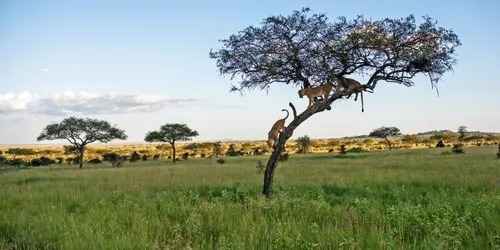
One Wild Land, Two Countries: Kenya Tanzania
Every few weeks, a guest asks us the same question: “Should we do Kenya or Tanzania?” After years of guiding in both, our honest answer is that the animals never really chose. In the Kenya Tanzania borderlands they walk, graze and swim across a border that exists only on maps, and so many of the things that make a safari special are shared between the two countries. Here are the connections we find most interesting, and a few facts to take on your next game drive.
Kenya Tanzania by the Numbers
- About 25,000 km²: the Serengeti-Mara ecosystem.
- About 1.5 million: wildebeest on the move.
- About 400 km: the length of the Mara River, from Kenya to Lake Victoria.
- 5,895 m: Kilimanjaro, Africa’s highest peak.
- Kiswahili: the shared language, in which “safari” means journey.
- 3 countries: Kenya, Tanzania and Uganda share Lake Victoria.
A Single Landscape with a Line Drawn Through It
Kenya’s Masai Mara covers roughly 1,510 km², while Tanzania’s Serengeti National Park is about ten times larger, at around 14,763 km². Together with the surrounding reserves and conservation areas, they form one ecosystem of roughly 25,000 km².
For a tourist, that means the scenery barely changes when you cross over: the same open plains, the same flat-topped acacias, the same big skies. What changes is the style of safari, the lodges and the crowds, which is why many guests enjoy seeing both. For a side-by-side comparison, read our guide to Kenya vs Tanzania safari.
The Great Migration Doesn’t Carry a Passport
Around 1.5 million wildebeest, along with hundreds of thousands of zebras and gazelles, travel in a giant loop through the ecosystem, covering up to about 1,800 km a year. They follow the rains and the fresh grass, not the calendar, so timing shifts a little each year. Roughly, it looks like this:
- January to March, southern Serengeti and Ndutu, Tanzania: Calving season, with huge herds, many newborns and predators close by.
- April to June, central and western Serengeti, Tanzania: The herds gather and head north, and the Grumeti River crossings can begin.
- July to October, northern Serengeti and the Masai Mara, Kenya: The Mara River crossings, the best-known part of the migration.
- November to December, back into the Serengeti, Tanzania: Short rains bring the herds south again.
During the calving season in the south, hundreds of thousands of calves are born in just a few weeks, and a wildebeest calf can stand and run within minutes of birth. By July, the herds have travelled north and it is Kenya’s turn to host them. Seeing both ends of the journey is the only way to understand the whole story. Read our month-by-month guides to the best time to visit Ndutu, the best time to visit the Serengeti and the best time to visit Masai Mara.
The Mara River Links Two Countries and One Lake
The Mara River begins in Kenya’s Mau Forest, flows about 400 km across the Masai Mara and the northern Serengeti, and empties into Lake Victoria. It is the main source of water for the dry season, and home to big Nile crocodiles and hippo pods that are part of every river crossing.
It also teaches a useful lesson: forests in Kenya’s highlands help keep water flowing to wildlife in Tanzania. Protecting one side protects the other. Lake Victoria itself is shared by Kenya, Tanzania and Uganda, and is the largest tropical lake in the world.
The Maasai: Neighbours Long Before the Border
The Maasai people speak Maa and have been herding cattle across this region for centuries, moving with the seasons long before anyone drew a line between Kenya and Tanzania. Well over a million Maasai live across the two countries today, and families still have relatives on both sides.
You can see different approaches to sharing land with wildlife. In Kenya, community conservancies around the Mara allow Maasai landowners to earn from tourism while keeping their grazing land. In Tanzania, the Ngorongoro Conservation Area is a multiple land-use area, where pastoralists and wildlife share the crater highlands. Visiting a community respectfully, with a local guide, is one of the most memorable parts of any trip. See our guide to the best time to visit Ngorongoro Crater.
Kilimanjaro, Best Photographed from Kenya
At 5,895 metres, Kilimanjaro is the highest mountain in Africa and the tallest free-standing mountain in the world. It stands in Tanzania, yet some of the best photographs of it are taken from Kenya’s Amboseli National Park, where the mountain rises above the plains behind herds of elephants.
Our tip is to get up early. Clouds usually gather around the summit by mid-morning, but at sunrise the peak is often clear. So the postcard picture of an African elephant under snow-capped Kilimanjaro is, quite literally, a Kenya and Tanzania collaboration. Read our guides to Masai Mara vs Amboseli and luxury lodges in Amboseli.
Elephants, Rhinos and Flamingos That Ignore the Border
Kenya’s Tsavo is one of the biggest wildlife areas in the world, with Tsavo East and West together covering over 20,000 km². On its southern side it meets Tanzania’s Mkomazi National Park, so elephants, black rhinos and African wild dogs can use the same wider landscape. Tsavo’s elephants are famous for their red colour, which comes from dust-bathing in the red soil. Read our guide to Tsavo West and Mkomazi.
The Great Rift Valley connects the two countries too. Lake Natron in northern Tanzania is the main breeding ground for the lesser flamingos that colour the shores of Kenya’s Lake Nakuru and Lake Bogoria pink, so the flamingos you photograph in Kenya may well have been raised in Tanzania. Read our guides to Lake Natron and Ol Doinyo Lengai and Lake Bogoria.
A Shared Language, and the Word “Safari” Itself
Kiswahili is spoken across both countries, and the word safari simply means “journey” in it. A few words go a long way: simba (lion), tembo (elephant), twiga (giraffe) and, of course, hakuna matata. Guides in Kenya and Tanzania will happily teach you more, and you will hear the same phrases on both sides of the border.
The coast tells the same story. Kenya’s Mombasa and Lamu and Tanzania’s Zanzibar grew up on the same Indian Ocean trade routes, and both Lamu Old Town and Stone Town in Zanzibar are UNESCO World Heritage Sites. Many guests finish a bush safari with a few days of beach and Swahili food on either coast. See our guides to Diani Beach and Stone Town and Jozani Forest.
Putting Kenya and Tanzania Together
There are many ways to link the two countries. A popular one follows the animals:
- Start in Nairobi for a gentle arrival, then head to the Masai Mara for big cats and, in season, the river crossings.
- Cross into Tanzania by road (most travellers use Namanga, with Nairobi to Arusha around 280 km) or by flight, to explore the Serengeti.
- Add Ngorongoro Crater for a day among rhinos, lions and flamingos on the crater floor.
- Finish at the coast in Diani or Zanzibar, depending on where your route ends.
For where to sleep in the Serengeti, see our guide to Serengeti accommodation, and for the best months across the whole country, read our guide to the best time to visit Tanzania.
Entry Rules for Kenya and Tanzania
Kenya and Tanzania have separate entry requirements, and the East Africa Tourist Visa does not include Tanzania, so check the latest rules before you travel. Both countries now also require mandatory inbound travel health insurance. Kenya’s applies to most visitors through the eTA application since 6 October 2026, at about US$44, and Tanzania began its own US$44 requirement on 1 October 2026. Budget for both if you cross the border. Read our guides to the Kenya visa for tourists and mandatory Kenya travel insurance. You can also check park information on the Kenya Wildlife Service and Tanzania National Parks Authority websites.
Kenya or Tanzania? Our Favourite Answer Is Both
So, Kenya or Tanzania? Our favourite answer is both. The wildlife already treats them as one place, and with a little planning, so can you.
Visit Yulle Adventures for itineraries and quotations for your next safari. Call us on 254 769 841 010, browse our Kenya safari packages and Tanzania safari packages, or request a quote.