

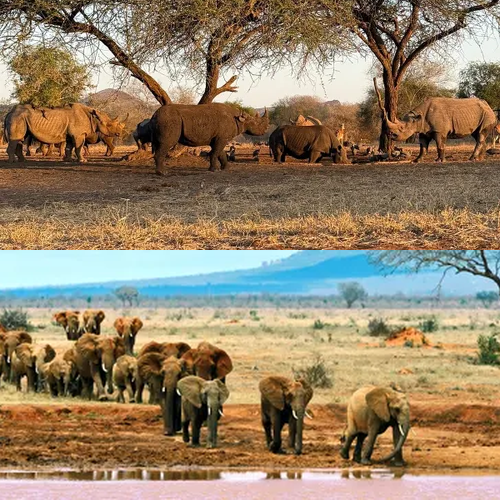
Two Parks, One Border, One Giant Wilderness
Tsavo West and Mkomazi, two national parks on either side of the border that belong to one of the largest protected wilderness areas in Africa. On one side lies Kenya's Tsavo West National Park, and on the other, Tanzania's Mkomazi National Park. Most safari-goers never think about this pairing, which is exactly why it is worth knowing.
One Ecosystem, Two Countries
Mkomazi shares an unfenced border with Tsavo West, and together with Kenya's Tsavo parks it forms a single ecological unit of roughly 43,000 square kilometres, which makes it one of the largest protected areas on earth. It is described as the second largest transboundary ecosystem in East Africa, after the Serengeti-Mara.That shared land matters. Animals do not stop at the border, so conservation on one side helps the other. Mkomazi even acts as a wet-season refuge for elephants coming from neighbouring Tsavo. Understanding Tsavo West and Mkomazi as one landscape, rather than two separate parks, is the key to appreciating either of them.
Tsavo West: Lava, Springs and Rugged Hills. Tsavo West was established in 1948 and covers about 9,065 square kilometres. It is greener and more dramatic than its sister park, Tsavo East, with volcanic hills, rocky outcrops and clear springs.
Where the Devil Left His Mark. The Shetani Lava Flow is one of Tsavo West's strangest sights. "Shetani" means "devil" in Swahili. The folded black lava spreads across the savannah near the Chyulu Hills for about 50 square kilometres. Local people once believed evil spirits had created the jagged black landscape, and walking across it, it is easy to see why. Nearby, the Chaimu Crater is a volcanic cinder cone you can climb for a view over the plains.
The Springs That Take 25 Years to Arrive. Mzima Springs is an oasis that produces around 250 million litres of fresh water a day. The water starts as rain on the Chyulu Hills. It seeps through the volcanic rock, where it may spend about 25 years before emerging roughly 50 kilometres away at Mzima. Hippos and crocodiles live in the clear pools, and an underwater viewing chamber lets you watch fish and hippos from below.
The Rhinos That Vanished and Returned
Both parks tell the same hopeful story, and it is one of the strongest reasons to visit Tsavo West and Mkomazi together. In the 1960s, more than 400 black rhinos roamed Mkomazi, but by the late 1980s there were none. Poaching had wiped them out across much of East Africa.In Tsavo West, the response was the Ngulia Rhino Sanctuary. It was established in 1986 as a guarded enclave, beginning with just nine animals. Today it is one of Kenya's most important rhino strongholds, protected by fences and round-the-clock rangers. Mkomazi followed. Conservationist Tony Fitzjohn led a roughly 20-year restoration effort, and black rhinos translocated from South Africa were introduced into a fenced sanctuary of about 70 square kilometres, where they have bred. Fitzjohn had worked with George Adamson of Born Free fame, and a foundation in both men's names still supports the work.
Mkomazi: Tanzania's Hidden Gem
Mkomazi is one of Tanzania's least-visited parks. It covers over 3,234 square kilometres, dominated by acacia and commiphora bush, and it began as a game reserve in 1951 before becoming a national park. It is one of the driest areas in Tanzania, and its name means "little water" in the local Pare language. Rising above the plains, the Pare and Usambara mountains give it a dramatic backdrop.Alongside rhinos, Mkomazi is known for African wild dogs, which are endangered. Wild dogs are nomadic and might be seen almost anywhere in the park, but black rhinos are kept within the fenced sanctuary for their safety. Other animals include fringe-eared oryx, lions, elephants, giraffes and spotted hyenas. It is also a rewarding park for birds.
Planning a Trip to Tsavo West and Mkomazi
| Planning | What to know |
Tsavo West
| About 9,065 square kilometres, reached by road or air from Nairobi and Mombasa, with lodges and camps inside the park |
Mkomazi
| Zange gate is about 112 kilometres from Moshi. Few visitors, so expect quiet roads |
Best time
| Generally the dry months for easier wildlife viewing. The wet season, November to May, brings elephants from Tsavo into Mkomazi |
How long
| 2 to 3 nights in Tsavo West, and 1 to 2 days in Mkomazi |
Crossing the border
| Visitors normally enter each park from their own country's side, so confirm routes and requirements with your operator |
Who it suits
| Repeat visitors, conservation-minded travellers and anyone who wants wilderness without crowds |
Why Tsavo West and Mkomazi Belong on Your List
You will not find the crowds of the Mara or the Serengeti here. What you will find is space, silence and a conservation success story that is still unfolding. Tsavo West gives you volcanic drama and spring-fed oases, and Mkomazi gives you solitude and a close look at some of Africa's rarest animals. Together, Tsavo West and Mkomazi show what a wilderness looks like when two countries protect it as one.
Ready to explore beyond the famous parks? Contact us at Yulle Adventures to build a Tsavo West and Mkomazi itinerary, or to combine it with Amboseli and Kilimanjaro for a full cross-border adventure.