

Safari Animal Checklist: What to Expect
Ask most first time travelers what they want to see on safari and the answer is almost always the Big Five. But anyone who has spent even three days in the Masai Mara or the Serengeti knows that the real story is much bigger. A proper safari animal checklist stretches far beyond lions and elephants to include speedy cheetahs, comical warthogs, dramatic raptors, and reptiles basking on riverbanks. This guide walks through everything you can realistically expect to see on a Kenya and Tanzania safari, how sightings change by park and season, and how to set expectations that leave you thrilled rather than disappointed.
In This Guide
- The Big Five Explained Briefly
- Other Iconic Mammals on Your List
- Primates You Will Meet Along the Way
- Small and Often Missed Wildlife
- Birdlife Highlights Worth Watching For
- Reptiles and Water Dwellers
- How Sightings Vary by Park and Season
- Realistic Expectations for a Multi Day Safari
- Building Your Own Safari Animal Checklist
- Frequently Asked Questions
The Big Five Explained Briefly
The term Big Five was coined by big game hunters describing the five animals hardest to hunt on foot, not the five most beautiful or common. Today it refers to lion, leopard, elephant, buffalo, and rhino, and it remains the backbone of almost every safari animal checklist shared online. Each of these animals behaves differently and requires a different approach to spot reliably, which is part of why guides treat them as a benchmark rather than a guarantee.
Lions are usually the easiest of the five to find in Kenya and Tanzania because they live in prides and rest in open grassland for much of the day. Leopards are solitary, nocturnal hunters that favor thick cover, so sightings depend heavily on a sharp guide and a bit of luck. Elephants travel in family herds and are easy to locate near water sources, while buffalo move in large, dusty herds that are hard to miss once you are in the right habitat. Rhinos, both black and white, are the rarest due to past poaching pressure and are now concentrated in protected sanctuaries.
For a deeper breakdown of where and when each of these five animals is most active, our guide to the Big Five in Kenya covers timing park by park.
What often surprises first time visitors is how differently each of the five animals is tracked by guides on the ground. Elephant and buffalo movement is read through dung freshness and recent footprints, while lion prides are frequently monitored over months or years, so an experienced driver may already know roughly where a particular pride is likely to be resting that morning. Leopard and rhino sightings rely far more on radio updates shared between vehicles and rangers, since both animals are elusive and spread across wide territory.
Understanding this behind the scenes effort helps explain why a morning spent searching patiently for a leopard can feel just as rewarding as an easy lion sighting minutes after entering the gate, which is part of why this safari animal checklist treats each species differently.
Other Iconic Mammals on Your List
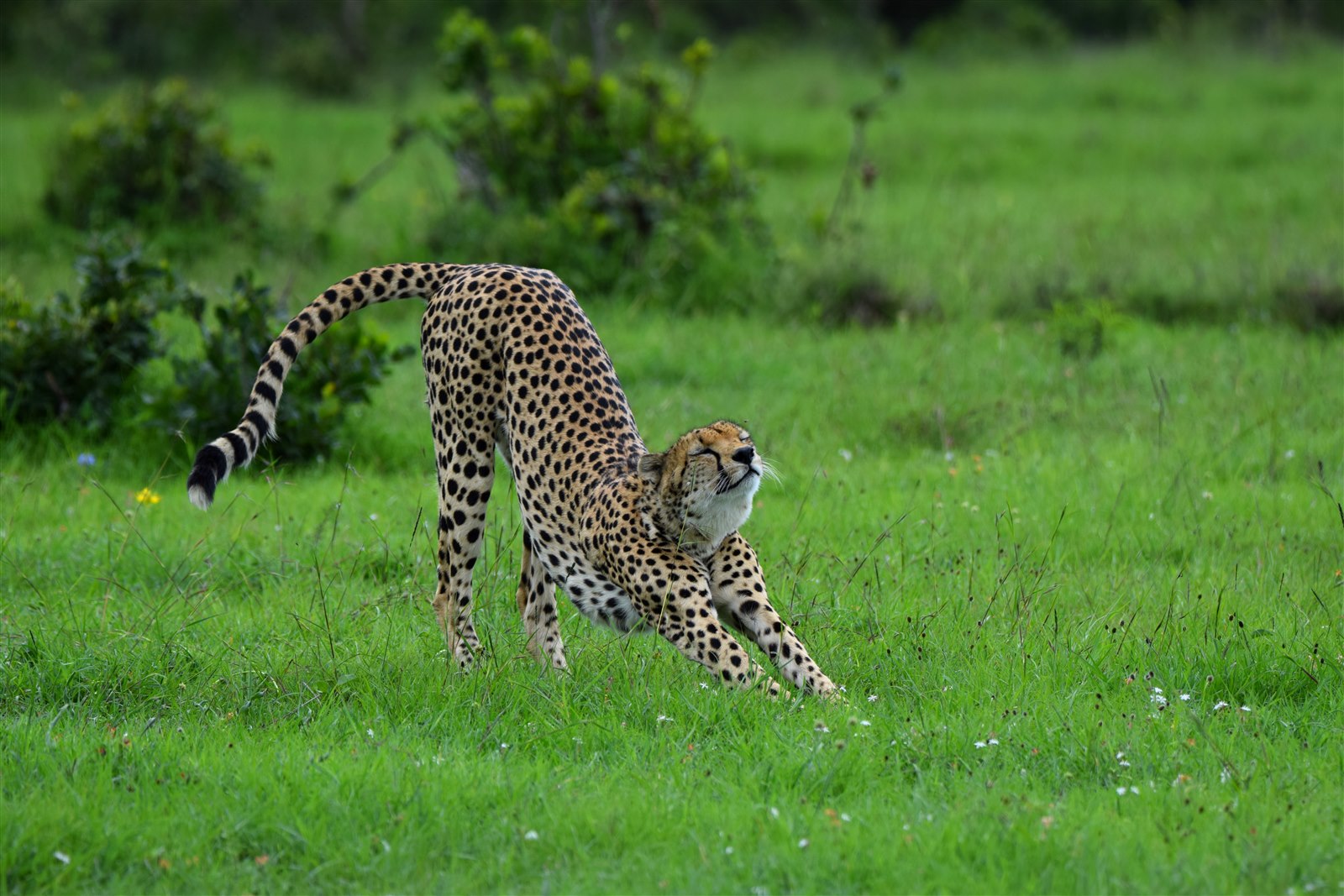
Once the Big Five are checked off, most travelers quickly realize that some of their favorite sightings come from animals outside that famous group. Cheetahs are a perennial highlight because of their speed and the drama of a daylight hunt, and certain coalitions in the Masai Mara have become minor celebrities in their own right. If you want to learn more about one particularly famous group, our article on the Tano Bora cheetah coalition tells their story in detail, and no safari animal checklist feels complete without them.
Giraffes and zebras are so visually striking that they often steal the show from the Big Five entirely, and both are common enough that you are almost guaranteed multiple sightings per day in the main safari circuits. Hippos gather in pods along rivers and lakes, grunting and jostling for position, while spotted hyenas are far more intelligent and social than their reputation suggests, often seen denning with pups near termite mounds.
Wildebeest, especially during the Great Migration months, can appear in herds so large that they change the entire landscape, thundering across rivers and plains in a spectacle that draws visitors from around the world and dominates many a safari animal checklist all on its own.
Beyond the headline species, these mammals also shape how a day on safari unfolds. A pod of hippos grunting near a riverbank often signals a good spot to watch for crocodiles and herons at the same time, while a line of zebra moving steadily across open plains can lead a sharp guide straight toward a resting pride of lions nearby. Hyena dens are particularly rewarding in the late afternoon, when pups emerge to play while adults rest nearby, offering a rare chance to observe family behavior up close.
Learning to read these small clues turns a simple drive into something closer to detective work, with every herd and track offering a hint about what else might be close by, which is exactly the kind of detail a good safari animal checklist should capture.
Primates You Will Meet Along the Way
Primates rarely headline a safari animal checklist, yet they are almost impossible to avoid once you are in the bush. Olive baboons live in large, noisy troops and are frequently seen along roadsides, around lodges, and foraging through open grassland, displaying complex social behavior that is fascinating to watch for just a few minutes. Vervet monkeys are smaller, quicker, and often found in wooded areas near camps, where their curiosity sometimes gets the better of them around unattended bags or picnic tables.
While Kenya and Tanzania are not primary destinations for gorilla or chimpanzee trekking, travelers who extend their trip into Uganda can add mountain gorillas and chimpanzees to an already impressive mammal list. Within the classic Kenya and Tanzania safari circuit, though, baboons and vervet monkeys are the primates you should expect to see nearly every single day, often providing some of the most entertaining candid photographs of the entire trip and an easy early addition to any safari animal checklist.
Guides often point out subtle differences between the troops you encounter, such as which baboon is dominant within a group or how vervet monkeys use distinct alarm calls to warn of specific threats like eagles or snakes. These details rarely make it into brochures, yet they add genuine depth to an afternoon spent parked beside a troop grooming and playing in the shade. Travelers who slow down and watch primate behavior for even ten minutes often come away with a far richer understanding of social structure in the wild than they expected from what first looked like a minor sighting.
Small and Often Missed Wildlife
It is easy to focus so intently on big cats and elephants that smaller creatures slip past unnoticed, but a sharp eye and a patient guide can turn these sightings into trip highlights. The dik-dik, one of the smallest antelope species in the world, moves in shy pairs through brush and is often spotted darting away from the vehicle rather than standing in the open. Warthogs, by contrast, are bold and frequently graze in full view near lodges, trotting along with their tails held straight up like little flags, an easy early tick on any safari animal checklist.
Mongoose species, including the banded and dwarf varieties, travel in tight family groups and can be seen scurrying between burrows, especially in the early morning. Bat-eared foxes are a special treat for anyone touring the plains of the Serengeti or the Mara, using their oversized ears to detect insects underground before digging them out with surprising speed. None of these animals get the same attention as the Big Five, yet seasoned safari guides often say that spotting a healthy population of smaller wildlife is actually a sign of a thriving, well balanced ecosystem.
Patience pays off especially well with these smaller species, since many of them are active during the cooler early morning and late afternoon hours rather than the heat of midday. A guide who slows the vehicle near a termite mound or a patch of dense scrub is usually watching for exactly this kind of wildlife, even when nothing is immediately visible. Travelers who ask their driver to pause occasionally, rather than rushing between big sightings, are often rewarded with a dik-dik pair slipping through the grass or a mongoose family darting between burrows just a few meters from the road.
Birdlife Highlights Worth Watching For
No safari animal checklist is complete without birds, and Kenya and Tanzania happen to host some of the richest birdlife on the African continent. The ostrich, the largest bird on earth, is a near constant presence on open plains, while the secretary bird stalks through grassland with its distinctive long legs and quill like head feathers, hunting snakes and insects on foot rather than from the air. Raptors are abundant too, with martial eagles, tawny eagles, and several species of vulture frequently seen perched on acacia trees or circling above a fresh kill.
Lake Nakuru and other soda lakes in the Rift Valley are famous for enormous flocks of flamingos, which can turn entire shorelines pink when conditions are right. Birders who want to plan a trip specifically around seasonal movements and prime viewing locations should look at our dedicated guide to birdwatching in Kenya, which breaks down the best places and times of year in far more depth for anyone building a bird-focused safari animal checklist. Even travelers who do not consider themselves birders tend to come away impressed by just how colorful and varied the birdlife turns out to be.
Beyond the headline species, smaller birds such as lilac breasted rollers, superb starlings, and various species of hornbill add constant flashes of color to every drive, often perching close enough to the vehicle for excellent photographs. Water birds like herons, storks, and the striking saddle billed stork gather along rivers and marshes, particularly during the wetter months when feeding conditions improve. Many guides carry a simple bird field guide in the vehicle, and borrowing it for a few minutes can turn an otherwise quiet stretch of the drive into a surprisingly engaging identification game for the whole group.
Reptiles and Water Dwellers
Reptiles rarely make the marketing brochures, but they are a memorable part of any safari animal checklist, particularly around rivers and lakes. Nile crocodiles lie motionless along riverbanks, especially at famous crossing points where wildebeest and zebra brave the water during migration season, making for some of the most tense and dramatic wildlife footage captured anywhere in Africa. Monitor lizards, meanwhile, are often seen basking on rocks or moving along the water's edge, their size and prehistoric appearance surprising many first time visitors and earning a place on almost every safari animal checklist.
Smaller reptiles such as agama lizards, with their vivid blue and orange coloring, are common around camps and lodges and make for easy, low pressure photography between game drives. While reptiles will never dominate a trip the way predators do, they round out the ecosystem story your guide will tell you, showing how predators, prey, and scavengers of every size depend on the same rivers and waterholes to survive, rounding out a thorough safari animal checklist.
Guides often use a crocodile sighting as a natural teaching moment, explaining how these ancient predators time their ambushes around the seasonal movement of migrating herds. Watching a crocodile remain motionless for long stretches before a sudden, explosive strike gives visitors a very different sense of predation than the chases associated with lions or cheetahs. For travelers interested in photography, the stillness of reptiles also makes them far easier subjects than fast moving mammals, rewarding anyone willing to wait quietly at a riverbank for a few extra minutes during a game drive.
How Sightings Vary by Park and Season
Not every park delivers the same safari animal checklist, and timing matters as much as location. The Masai Mara is renowned for predator density year round and becomes extraordinary during the Great Migration months, roughly July through October, when wildebeest and zebra cross the Mara River in massive numbers. For a sense of exactly which species concentrate where inside this ecosystem, our guide to animals in the Masai Mara is a useful companion to this checklist.
Tanzania's Serengeti mirrors much of the Mara's drama but on a larger scale, while Ngorongoro Crater offers a compact, high density environment where rhino sightings are more likely than almost anywhere else in East Africa. Amboseli is unmatched for elephant herds set against the backdrop of Kilimanjaro, and Lake Nakuru remains the top choice for flamingos and rhino together in one compact park, a combination that quickly fills out a safari animal checklist. The dry season generally concentrates animals around permanent water sources, making sightings easier, while the wet season brings lush scenery, newborn animals, and excellent birdlife, though some tracks can become harder to navigate, another reason seasonal timing matters for your safari animal checklist.
Park choice also affects which smaller and often missed species you are likely to encounter. Amboseli and Tsavo tend to favor sightings of elephant herds and dik-dik in the surrounding scrubland, while the open plains of the Serengeti and Mara are better suited to spotting bat-eared foxes and large raptor concentrations around fresh kills. Travelers planning a longer itinerary across several parks benefit from discussing priorities with their safari company in advance, since a route built around birding will look quite different from one built primarily around predator sightings or the migration crossings.
Realistic Expectations for a Multi Day Safari
On a well planned four to seven day safari across two or three parks, most travelers tick off the entire Big Five along with the vast majority of this expanded safari animal checklist. Lions, elephants, buffalo, giraffes, zebras, hippos, and various antelope species are seen almost daily, while cheetah, leopard, and rhino sightings depend more on luck, park choice, and guide experience. A good safari company will combine parks strategically, pairing a predator rich reserve with a rhino sanctuary or an elephant stronghold to maximize the odds of a complete list.
It is worth remembering that wildlife sightings can never be fully guaranteed, since animals move freely across vast, unfenced landscapes. Guides use tracks, radio networks, and years of experience to improve the odds dramatically, but patience and realistic expectations make the experience far more enjoyable. Travelers who treat every sighting as a bonus rather than an entitlement tend to report the most satisfying trips, regardless of how many boxes they technically tick off their safari animal checklist.
It also helps to understand how a typical day is structured, since that shapes what you are likely to see. Early morning drives tend to favor predators finishing a night hunt or settling down to rest, while late afternoon outings often bring out grazing herds, hyenas emerging from their dens, and birds becoming active again after the heat of midday. Midday breaks, often spent back at camp, are not wasted time, since this is precisely when much of the bush is resting and visibility would be poor regardless of effort. Building your itinerary around these natural rhythms, rather than fighting them, consistently produces better results than trying to drive constantly from dawn until dusk.
Building Your Own Safari Animal Checklist
If you want to track your own sightings, it helps to organize your personal safari animal checklist into simple categories before you travel: predators, large herbivores, primates, small mammals, birds, and reptiles. Keeping a small notebook or phone app running during game drives turns the trip into something closer to a treasure hunt, and many families enjoy comparing notes each evening around the campfire. Your guide will often know within the first day which species are particularly active in that specific park at that specific time, so asking directly is always worthwhile when refining your safari animal checklist.
Conservation bodies such as the Kenya Wildlife Service also publish useful background on species status, protected areas, and conservation efforts across the country's parks and reserves. Reading a little beforehand not only enriches the experience but also helps travelers understand why certain animals, such as rhino, remain rare even inside well managed sanctuaries.
Frequently Asked Questions
How many animals can I realistically expect to see on safari? On a typical multi day trip across two or three parks, travelers commonly see well over thirty species, including the full Big Five, several primate species, dozens of bird species, and a range of smaller mammals and reptiles.
Is it possible to see all of the Big Five in one trip? Yes, though rhino and leopard sightings depend on park choice and a bit of luck. Combining a predator dense reserve with a rhino sanctuary greatly improves the odds within a single itinerary.
What is the best season for the widest variety of sightings? The dry season generally concentrates animals near water sources, making general sightings easier, while the wet season brings newborn animals and outstanding birdlife, so both have distinct advantages depending on your priorities.
Are smaller animals like dik-dik and mongoose hard to spot? They can be, since they are shy and often camouflaged, but an experienced guide who knows their habits and favored habitats will usually find several examples over a few days of driving.
Do I need a separate trip to see primates like gorillas? Yes, mountain gorillas and chimpanzees are found in Uganda rather than the classic Kenya and Tanzania circuit, so travelers wanting those species typically extend their itinerary into a separate region.
Whether you arrive focused solely on the Big Five or determined to document every creature from flamingos to monitor lizards, East Africa consistently delivers one of the richest wildlife experiences on the planet. Use this safari animal checklist as a starting point, stay flexible with your itinerary, and trust your guide's knowledge of seasonal movement patterns. The result is almost always a trip filled with far more memorable sightings than most travelers ever expected to tick off their list.