

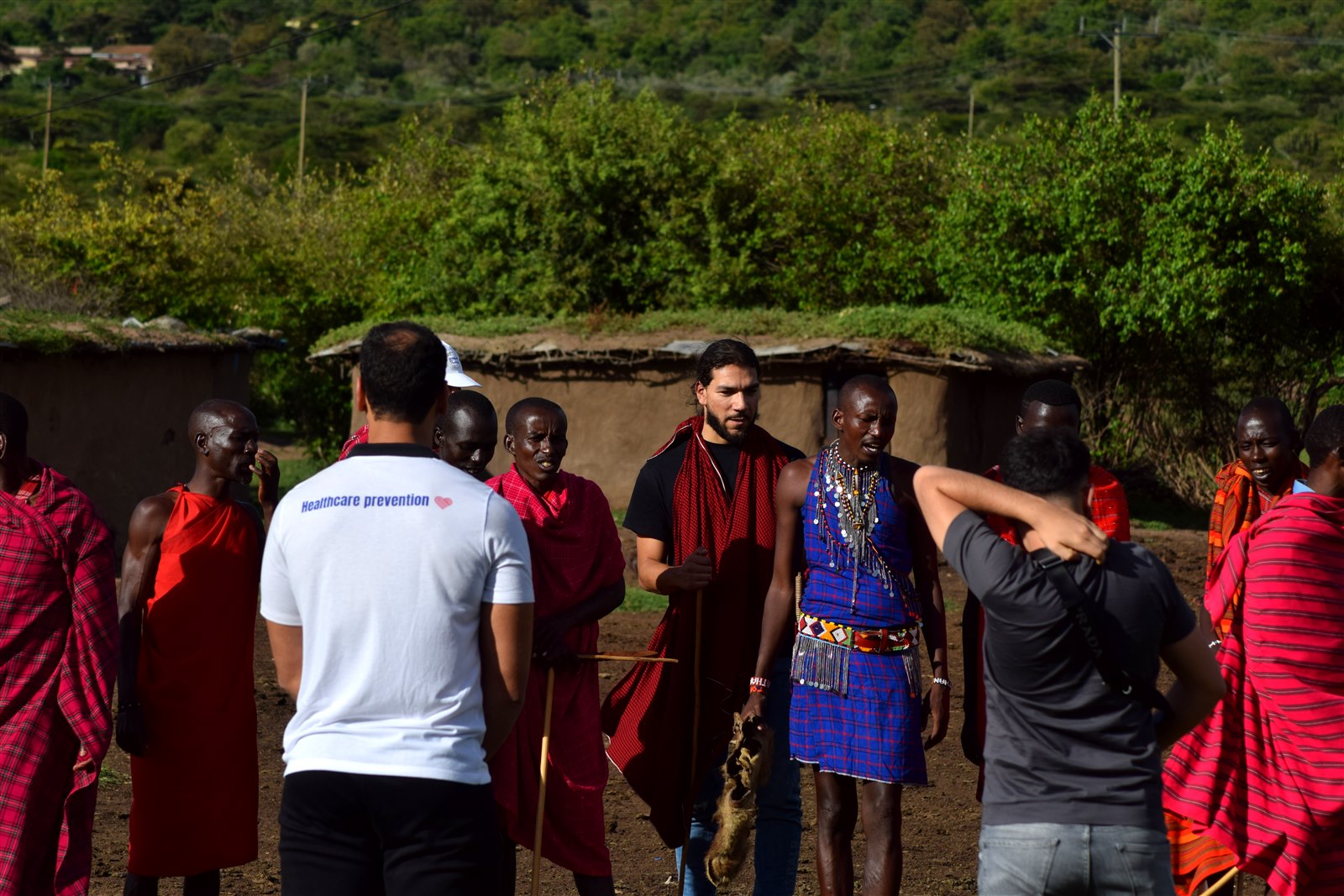
A Maasai village visit near the Masai Mara is one of the few moments on a Kenya safari when the trip stops being only about animals and starts being about people. For a couple of hours, the rhythm changes: instead of scanning the grass for a lion's ear twitching, you are sitting in the shade of a low mud house, watching a line of warriors rise impossibly high off the ground, or listening to a grandmother explain why the beads on her collar are arranged in exactly that pattern.
This guide explains what a Maasai village visit actually involves, who the Maasai are and why their homeland surrounds one of Africa's most famous reserves, and how to choose a visit that feels respectful rather than staged. It also covers etiquette, photography, and how a Maasai village visit usually fits into a wider Mara itinerary.
In This Guide
- Who Are the Maasai?
- The Maasai and the Land Around the Mara
- What to Expect on a Maasai Village Visit
- Inside a Traditional Manyatta
- Beadwork, Jewelry and Buying Direct
- Staged or Authentic? An Honest Look
- Etiquette: Photos, Dress and Tipping
- How Visits Are Usually Arranged
- Best Time of Day for a Visit
- Children, Schools and a Changing Community
- The Meaning Behind the Jumping Dance
- Combining Culture With Conservancy Life
- Frequently Asked Questions
Who Are the Maasai?
The Maasai are a semi-nomadic pastoralist people whose traditional territory stretches across southern Kenya and northern Tanzania, including the land that borders the Masai Mara National Reserve. Cattle sit at the center of Maasai identity, not just as food or income but as a measure of status, a form of social currency, and a subject woven into songs, proverbs and everyday conversation. A Maasai village visit almost always touches on this relationship with livestock early on, because it explains so much of what follows.
Maasai society is organized around an age-set system, where boys move together through childhood, warriorhood (moran) and eldership as a group, taking on different responsibilities at each stage. Warriors traditionally protected the herds and the community, a role that still carries real cultural weight even as many young Maasai now also attend school, work in tourism or move between village life and nearby towns. A good Maasai village visit will introduce this age-set structure rather than leaving you with a flat, timeless impression of "tribal life."
The Maasai and the Land Around the Mara
The Masai Mara takes its name directly from the Maasai people who have grazed cattle across this ecosystem for generations. The reserve itself is government land, but much of the wider landscape, including many of the private conservancies bordering it, sits on land owned by Maasai families and communities. Understanding this context changes how a Maasai village visit feels: you are not visiting a museum exhibit, but a living community with a direct, ongoing stake in the same landscape the wildlife depends on.
Many of the conservancies around the Mara were specifically created through lease agreements with Maasai landowners, who receive income in exchange for keeping the land open for wildlife rather than fencing it for farming or settlement. Our guide to the Masai Mara conservancies explains this model in more detail, and it is worth reading alongside this one, because a Maasai village visit and a conservancy stay are often two sides of the same community relationship.
That connection matters for travelers because it means tourism revenue, including the fees from a Maasai village visit, often flows back into the same community whose land supports the wildlife you came to see. It is one of the more direct examples in African tourism of conservation and culture reinforcing each other rather than competing.
What to Expect on a Maasai Village Visit
A typical Maasai village visit begins with a welcome at the entrance to the manyatta, often with singing. From there, warriors usually perform the adumu, widely known as the jumping dance, in which men take turns leaping straight upward from a standing position, competing good-naturedly to jump the highest while the group chants and sings around them. It is energetic, loud and genuinely impressive, and most visitors end up drawn into at least trying a jump themselves.
After the dancing, a guide, often a Maasai elder or English-speaking community member, walks you through daily life: how children are named, how marriages are arranged, what a warrior's typical day once looked like, and how modern pressures like land subdivision and schooling are changing the community. This narrated walk is usually the heart of a Maasai village visit, and the best guides answer direct questions honestly rather than reciting a fixed script.
Fire-Starting and Other Demonstrations
Most visits include a short demonstration of traditional fire-starting, using two sticks and dried dung or grass as tinder, rubbed quickly until a coal forms. It usually takes less time than visitors expect, and guides are generally happy to let you try it yourself, with mixed results. Some villages also demonstrate traditional medicine using local plants, or show basic tools and weapons still kept for ceremonial use.
Inside a Traditional Manyatta
A manyatta is a cluster of homes built by Maasai women from a frame of branches plastered with a mix of mud, sticks, grass and cow dung, which dries into a surprisingly durable, insulating wall. Homes are low, dark and compact by design, built to be easy to maintain and to keep cool during the day and warm at night. Visiting one is usually the most tactile part of a Maasai village visit, since you can touch the walls, see the sleeping areas, and understand the layout firsthand.
The settlement itself is typically arranged in a circle, with a thorn-bush enclosure, or boma, at the center used to protect cattle overnight from predators. This layout is not decorative; it is a direct, practical response to living alongside lions, hyenas and leopards, and guides on a Maasai village visit often point out how the circular design reflects that relationship with wildlife.
Family compounds often include several homes belonging to one man's wives and children, reflecting a traditionally polygamous social structure. Guides will usually address this directly if asked, and most travelers find the conversation genuinely informative rather than uncomfortable, provided questions are asked respectfully.
Beadwork, Jewelry and Buying Direct
Beadwork is one of the most visually striking parts of Maasai culture, and most Maasai village visit itineraries end with an opportunity to browse jewelry made by the women of the community. Colors and patterns traditionally carry meaning, red for bravery and unity, blue for the sky and energy, green for the land, though exact meanings can vary between communities, and it is worth asking rather than assuming.
Buying directly from the women who made a piece is one of the more meaningful ways tourism income reaches individuals rather than only the community as a whole. A Maasai village visit is a good opportunity to do this deliberately, choosing a piece you genuinely like rather than feeling pressured, and taking the time to ask who made it and what the pattern represents.
Staged or Authentic? An Honest Look
It is a fair question, and one worth asking before booking: is a Maasai village visit staged for tourists, or a genuine glimpse into real life? The honest answer is usually somewhere in between. Most villages that welcome visitors regularly have adapted parts of the experience, such as timing the jumping dance for groups or keeping a consistent English-speaking guide, specifically because of tourism.
That does not make the experience hollow. The homes are real homes, the people live in the community, and the cultural knowledge being shared is genuine, even if the format has been shaped by years of hosting visitors. A thoughtful Maasai village visit sits closer to a well-run cultural exchange than either a fully authentic slice of untouched life or a hollow performance, and most travelers find that framing more honest and more satisfying than either extreme.
What matters more than the staged-versus-authentic debate is who benefits. Ask your tour operator or lodge how the village visit fee is shared with the community, whether guides are paid fairly, and whether the same village is visited repeatedly in a way that builds a real relationship rather than treating it as a one-off tourist stop.
Etiquette: Photos, Dress and Tipping
Always ask before photographing individual people up close, even though group shots during the dancing are usually welcomed. Many guides will tell you clearly what is and is not appropriate to photograph, including whether cameras are welcome inside individual homes. A respectful Maasai village visit treats consent as the default, not an afterthought.
Modest, practical clothing is appropriate, similar to what you would already wear on a game drive. There is no need for anything especially formal, but swimwear or very revealing clothing is best avoided. If you buy jewelry or crafts, haggling lightly is normal and expected, but aggressive bargaining over small amounts tends to land poorly and is not worth the goodwill it costs.
Tipping your guide directly, separately from any entrance fee already paid by your tour operator, is appreciated and common practice after a Maasai village visit. Ask your safari operator in advance what is customary so you are not caught without the right approach on the day.
How Visits Are Usually Arranged
Most travelers do not book a Maasai village visit independently; it is arranged through the lodge, camp or tour operator running their Mara safari, often as an optional afternoon activity alongside game drives. Some camps have an established relationship with one specific village, visited regularly enough that the two sides know each other well, which tends to produce a more relaxed, less transactional atmosphere.
If a Maasai village visit is not already included in your itinerary, it is easy to ask your operator to add one, usually on a day with a shorter morning or evening game drive to make room. See our broader guide on a Masai Mara safari for how a cultural stop like this typically fits around the main wildlife activities, and browse our Kenya safari packages for itineraries where a village visit can be added.
Before you travel, check the latest UK government travel advice for Kenya for general guidance on visiting the country, including any relevant local customs or safety notes that may apply around the Mara region.
Best Time of Day for a Visit
Most lodges schedule a village stop in the late morning or mid-afternoon, deliberately avoiding the cooler dawn and dusk hours reserved for game drives, when predators are most active and light is best for photography. A mid-morning slot also suits the Maasai hosts, since by then the cattle have already been let out to graze and the household's early chores are finished, leaving people free to welcome guests without disrupting the working rhythm of the day.
Afternoon heat can make the dancing and walking feel more tiring, so carrying water and a hat is sensible whichever time slot your operator chooses. Ask in advance how long the stop will run, since some itineraries bundle it with a short nature walk or a stop at a local school or clinic supported by tourism revenue, which can extend the visit well beyond the core cultural programme.
Children, Schools and a Changing Community
It is increasingly common for a nearby primary school to be part of the wider programme, either as an optional add-on or as the destination for a portion of the fees collected from visitors. Many communities around the Mara now send most children to school rather than keeping them exclusively within traditional herding and homestead duties, a shift that guides are usually happy to discuss openly.
This generational change means a grandmother in full traditional dress might have grandchildren who are fluent in English, studying on a laptop, or working seasonally in a nearby camp's kitchen or front office. Rather than undermining the cultural value of the experience, most travelers find this blend of old and new one of the more interesting threads running through the visit, a reminder that living culture adapts rather than freezing in place for an audience.
Some schools welcome short, respectful visits if a guide arranges it ahead of time, though travelers should never simply turn up uninvited or hand out sweets, pens or money directly to children, since this can encourage begging and disrupt normal school routines. Donations are far better directed through the lodge, operator or an established community fund, which your safari team can usually point you toward if you want to contribute further.
Why It Adds Real Depth to a Safari
Game drives give you Kenya's wildlife. A Maasai village visit gives you a sense of the people who have shared this landscape with that wildlife for generations, and whose decisions about land use directly shape whether the ecosystem survives for the next generation too. The two experiences complement each other more than most first-time visitors expect.
Travelers who add a Maasai village visit to their Mara itinerary consistently describe it as one of the most memorable parts of the trip, not despite being different from the game drives, but because of it. It is a chance to ask questions, hear direct answers, and leave with a fuller picture of Kenya than wildlife alone can provide.
The Meaning Behind the Jumping Dance
The adumu is often the single image visitors remember most clearly, but it carries more weight than a simple performance for onlookers. Historically, the jumping dance let young warriors display strength, stamina and vitality in front of their peers, part of a broader set of rituals marking the transition from boyhood into full warrior status within the community's age-set system.
Singing accompanies the jumps, with deep, rhythmic chants rising and falling as individual warriors step into the circle to take their turn. There is a loose competitive element, since jumping notably higher than the group carries real social standing, but the atmosphere stays collaborative rather than tense, with warriors encouraging each other between turns.
Guides on a well-run visit will usually explain this background before the dancing starts, rather than leaving guests to interpret an unexplained spectacle. Understanding the layered meaning behind the jumping, rather than treating it as simply colorful, tends to be what separates a forgettable stop from a genuinely memorable one.
Combining Culture With Conservancy Life
Many of the private conservancies bordering the reserve blend wildlife viewing and cultural programming more deliberately than the main reserve itself can, since conservancies are built on direct partnerships with local landowners. Staying at a conservancy camp often means your guide, tracker or camp host is themselves Maasai, turning everyday conversations over meals into an informal extension of the cultural experience well beyond the scheduled homestead stop.
Some conservancies run community walks led by local guides, pointing out traditional uses for wild plants, grazing patterns, or the history of specific watering points, alongside the usual wildlife-spotting commentary. Pairing this kind of informal, ongoing cultural exposure with a dedicated homestead programme gives a noticeably fuller picture than either on its own, and it is worth asking your operator which camps offer this blended style of stay.
Frequently Asked Questions
Is a Maasai village visit worth doing? Most travelers find it one of the most memorable parts of their trip, offering genuine cultural insight alongside the wildlife-focused parts of a Mara safari.
How long does a typical visit last? Most visits last around an hour to ninety minutes, including the welcome, dancing, a homestead tour and time to browse beadwork.
Is it disrespectful to take photos? Group photos during dances are usually welcomed, but always ask before photographing individuals up close or the inside of homes.
Do the Maasai still live traditionally? Many blend traditional practices, including cattle herding and the age-set system, with modern life such as school, mobile phones and part-time work in tourism.
Can I buy jewelry directly from the women who made it? Yes, and it is one of the most meaningful ways for tourism income to reach individuals rather than only the wider community.
Should I tip after a Maasai village visit? Yes, tipping your guide separately is common practice; ask your safari operator what is typical before you go.
Plan Your Safari
A Maasai village visit is easy to add to almost any Masai Mara itinerary, and our team can arrange one alongside your game drives and conservancy stays. Contact us for a tailor-made Kenya safari, or browse our Kenya safari packages to see where a Maasai village visit fits naturally into your trip.