

Where Lava Meets Luxury: The Finest Camps and Lodges in Tsavo West
Tsavo West is Kenya's quiet giant. Black lava flows cut through green hills, springs run clear enough to read a newspaper through, and Kilimanjaro hangs above the western horizon on mornings when the haze lifts. It is wilder and less trodden than the Mara, and the handful of luxury properties scattered across it tend to feel like secrets rather than hotels.
The park covers roughly 9,000 square kilometres, yet it holds only a few dozen high-end rooms. That ratio is the point. You can drive for an hour here and meet nobody, which is increasingly rare in Kenyan safari country.
Why Tsavo West plays differently
Tsavo East is flat, red and open. Tsavo West is the opposite: hilly, volcanic and often densely vegetated, which means game viewing asks a little more patience and rewards it with drama.
Elephants here wear a famous coat of red dust. Lion, leopard and buffalo are all present, though the thick cover means sightings generally take work. Black rhino live under armed protection in the Ngulia Sanctuary, one of the better places in Kenya to see them.
The park also holds Mzima Springs, where around 220 million litres of filtered rainwater surface each day and an underwater viewing chamber lets you watch hippo move like slow submarines.
Finch Hattons
Finch Hattons is arguably the headline act. Named after the aristocratic hunter of Out of Africa fame, it sits beside a series of spring-fed pools where hippo graze the lawns after dark.
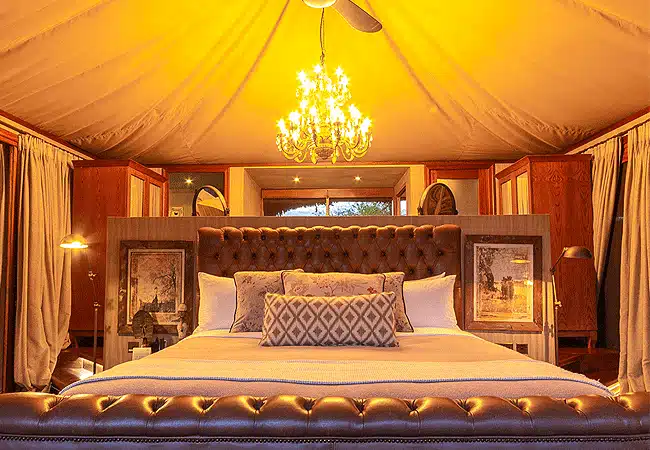
The tents are enormous, with freestanding baths, private decks and air conditioning, which few camps in Kenya bother with. There is a spa, a glass-fronted gym and a cellar that would not embarrass a city restaurant.
Crystal glassware and gramophone music at dinner lean deliberately into the 1920s fantasy. Some guests find it theatrical. Most find it irresistible.
Severin Safari Camp
Severin sits in open country near the Chyulu foothills, with roughly fifty tents under thatch and one of the better waterholes in the park directly in front of the dining area.
The camp runs its own spa, a swimming pool and a floodlit hide, and the night sky here is genuinely exceptional because there is almost no light for a hundred kilometres. Severin usually prices below Finch Hattons, which arguably makes it the sweet spot for travellers who want comfort without the full premium.
Kilaguni Serena Safari Lodge
Kilaguni claims to be Kenya's first lodge built inside a national park, opening in the 1960s. It perches on a rise with the Chyulu Hills behind and a busy waterhole below.
Rooms are solid and unfussy rather than opulent, but the view from the terrace, taking in both the waterhole and Kilimanjaro, is among the finest in East Africa. Elephant and buffalo often drink within photographing distance of breakfast.
Just beyond the boundary
Two properties on the park's northern edge deserve a mention, since many itineraries pair them with Tsavo West.
Campi ya Kanzi and Ol Donyo Lodge both sit on Maasai-owned land in the Chyulu Hills. Both offer walking, horse riding and night drives that are not permitted inside the national park, and both sit firmly at the top of the price scale.
What it costs
High-season rates at the luxury end typically run from USD 400 to USD 1,200 per person per night, sharing, usually on full board with game drives.
Park entry sits on top and is currently around USD 60 per adult per day for non-residents. Always confirm whether a quoted rate includes it, because the difference over four nights is considerable.
Getting there and when to go
The drive from Nairobi takes roughly five to six hours on the Mombasa Road, with Mtito Andei Gate the usual entry point. The Madaraka Express train to Mtito Andei offers a gentler alternative, and most camps will collect from the station.
Light aircraft serve several airstrips, including Finch Hattons and Kilaguni.
June to October and January to February generally bring the best viewing, when thinner vegetation pushes animals toward water. The green season turns the park spectacular for photography, though the grass grows tall and animals scatter.
Tsavo West does not hand you its wildlife. It makes you look. That, for many travellers, is exactly the appeal.