

Ngorongoro Crater Day Trip: Is One Day Enough?
Few questions come up more often when planning a Tanzania safari than whether a single day is enough to experience Ngorongoro properly. A Ngorongoro Crater day trip packs an extraordinary amount of wildlife viewing into a compact window, and for many travelers it delivers everything they hoped for: lions lounging in open grass, elephant bulls moving across the crater floor, and flamingos staining the edges of the soda lake pink. But a day trip also has real limits, and knowing them before you go helps you decide whether to squeeze the crater into a single morning or build in a night on the rim instead.
This guide walks through exactly what a Ngorongoro Crater day trip looks like from start to finish, what you can realistically expect to see, what you give up by not staying overnight, and who each option actually suits. By the end you should have a clear sense of which approach fits your own itinerary, your pace, and your appetite for an early start.
In This Guide
- What a Typical Day Trip Itinerary Looks Like
- What You Will Realistically See in a Day
- What You Might Miss by Not Staying Overnight
- How Long the Descent and Ascent Actually Take
- Who a Ngorongoro Crater Day Trip Suits
- Who Should Stay Overnight Instead
- Practical Tips for Your Day Inside the Crater
- Frequently Asked Questions
What a Typical Day Trip Itinerary Looks Like
Most lodges and camps near the crater rim start the day early, usually with a wake-up call well before sunrise. The goal is to reach the crater gate as it opens and begin the descent while the light is still soft and the air on the rim is cold enough to fog your breath. If you are approaching from Karatu or from a camp further out, your driver guide will factor in that extra driving time when planning your Ngorongoro Crater day trip, so the exact wake-up hour varies depending on where you spent the previous night.
Once you reach the crater gate, there is a short wait while permits and conservation fees are processed. This is also when you will usually swap into a vehicle better suited to the steep, narrow descent road if you have not already done so. The road down drops more than six hundred meters in a series of tight switchbacks, and your guide will take it slowly, partly for comfort and partly because the view opens up dramatically as you descend.
Once on the crater floor, the morning is dedicated to a long, unhurried game drive. This is prime time: animals that have been active overnight are often still moving, and the light is excellent for photography. Your guide will typically work a loop that touches the Lerai forest, the Mandusi swamp, and the edges of the soda lake, stopping wherever sightings demand it. A picnic breakfast or brunch is often eaten streamside or near one of the designated picnic spots, since there is no restaurant or café anywhere inside the crater itself.
By late morning or early afternoon, most day visitors continue exploring before beginning the ascent back up to the rim. Because only one road services exit traffic efficiently at busier times, guides try to time the climb to avoid the worst of the queue, which is one reason an early start pays off twice: once for the wildlife and once for the drive home.
What You Will Realistically See in a Day
Ngorongoro is often described as a wildlife bowl, and that description earns its reputation. The crater floor concentrates an unusually dense population of animals into a relatively small, enclosed area, which means a single Ngorongoro Crater day trip tends to deliver sightings that would take days to accumulate elsewhere.
Lions are almost a given on any Ngorongoro Crater day trip. The crater supports several well-studied prides, and because the terrain is open grassland rather than thick bush, spotting them resting in the shade of an acacia or patrolling near a kill is common even on a short visit. Elephants, mostly large bulls rather than full breeding herds, are frequently seen moving along the forest edges or crossing open plains, their dark shapes unmistakable against the pale grass.
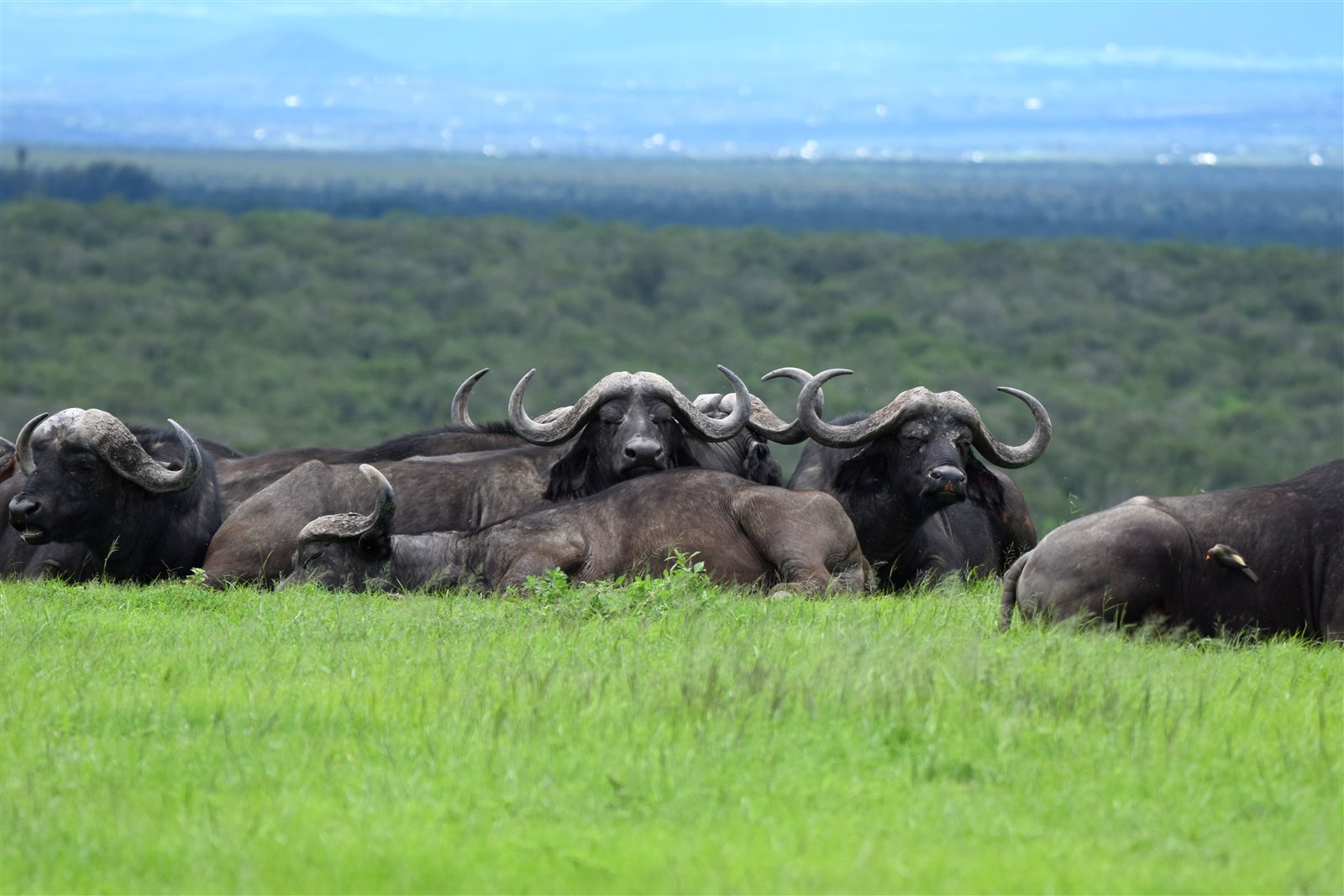
The soda lake, Lake Magadi, is one of the visual highlights of any Ngorongoro Crater day trip. Depending on water levels, thousands of flamingos gather along its margins, their pink coloring vivid against the white, mineral-crusted shoreline. Hippos wallow in the permanent swamps nearby, wildebeest and zebra graze across the plains in large mixed herds, and buffalo move in tight, dusty groups that can number in the hundreds.
The crater is also one of the more reliable places in Tanzania to see black rhino, a species that has become scarce elsewhere due to poaching pressure. Sightings are never guaranteed, since the population is small and the animals cover a lot of ground, but guides who work the crater daily know the areas where rhino are most often seen and will route the drive accordingly whenever a sighting has been reported.
Taken together, a well-run Ngorongoro Crater day trip can realistically produce sightings of lion, elephant, buffalo, hippo, flamingo, and with some luck, rhino, all within a few hours. That density of wildlife in such a contained space is precisely why the crater draws so many visitors who are tight on time but unwilling to compromise on quality.
Jackals, hyenas, and warthogs round out a typical sighting list, and golden jackal pairs are often spotted trotting along the grassland edges in the cooler morning hours. Because the crater floor is largely treeless grassland punctuated by forest patches and the swamp system, visibility is excellent, which means that even distant animals are usually easy to spot with binoculars. This open terrain is part of what makes a single Ngorongoro Crater day trip feel so productive compared with denser bush environments where sightings can be brief and partially obscured.
What You Might Miss by Not Staying Overnight
The case for staying on the rim rather than doing a Ngorongoro Crater day trip comes down to timing, crowding, and depth rather than to any single animal you cannot see otherwise. Travelers based at a rim lodge can enter the crater at first light, well before day-trip vehicles arrive from Karatu or the Serengeti side, and that early window often brings calmer wildlife and quieter roads.
Photographers in particular lose something by skipping an overnight stay. The soft, low-angle light of early morning on the crater floor is difficult to replicate once the day trip crowd arrives and the sun climbs higher. Predators that have been active in darkness are also more likely to still be moving, feeding, or interacting in those first hours, before the heat sets in and most animals retreat to shade.
There is also the matter of simple exploration time. A day trip has a hard deadline: the ascent road and the closing time at the gate. An overnight stay removes that pressure, allowing a second game drive the following morning or a slower, more deliberate pace through the afternoon before dusk. For travelers who want to linger at a sighting rather than move on to stay on schedule, that flexibility matters.
Crowding is the other factor to weigh against a Ngorongoro Crater day trip. Because so many travelers do choose a day trip rather than an overnight stay, the busier midday hours can see a cluster of vehicles at popular sightings, particularly near the lake and the main predator territories. Guests staying overnight can often time their second descent to avoid that peak, extending their comfortable viewing window considerably.
None of this means a day trip is inadequate. It simply means that an overnight stay buys you more flexibility, better light, and a quieter crater floor, which is worth knowing before you commit to one plan or the other.
How Long the Descent and Ascent Actually Take
The road connecting the rim to the crater floor is unpaved, narrow in places, and steep enough that vehicles move slowly by necessity. Covering the descent typically takes around thirty to forty-five minutes, depending on traffic at the switchbacks and how often your driver pauses to let you take in the view as the crater opens up below.
The ascent takes a similar amount of time, sometimes a little longer if there is a queue of vehicles leaving around the same hour, which tends to happen in the mid to late afternoon as day-trip guests head back toward the rim before the gate closes. Guides who run this route often plan the return leg to avoid the busiest stretch, sometimes by starting the ascent slightly earlier or by finishing the final game drive loop near the exit road.
Added together, descent and ascent account for roughly an hour to ninety minutes of a full Ngorongoro Crater day trip, which still leaves a substantial block of time, often five to six hours, for game viewing on the crater floor itself. That math is part of why a single day works reasonably well for most travelers: even after subtracting travel time on the access roads, the hours available for wildlife viewing are considerable.
Who a Ngorongoro Crater Day Trip Suits
A Ngorongoro Crater day trip tends to suit travelers who are combining several parks into one broader Tanzania itinerary and do not want to dedicate an extra night solely to the crater rim. This is especially common for guests moving between the Serengeti and Tarangire, or those following a route that already includes Lake Manyara, where the crater becomes one stop among several rather than a standalone destination.
It also suits travelers on a tighter overall schedule, families with younger children who find very early starts easier to manage when they know the night will be spent somewhere familiar rather than changing camps again, and anyone who has already experienced long, immersive game drives elsewhere and is looking for a concentrated, high-impact few hours rather than another full day of exploration.
If your broader plan already includes a multi-day circuit, for example a four day Serengeti and Ngorongoro Crater safari, a single descent into the crater often fits naturally into the route without requiring a dedicated overnight stop. The crater becomes a powerful finale or opening act to a trip that is already rich in wildlife, rather than a separate leg that needs its own logistics.
Repeat visitors to Tanzania also tend to gravitate toward a Ngorongoro Crater day trip rather than an overnight stay, simply because they already know what to expect and want to allocate their remaining nights to other parks such as Tarangire or the southern Serengeti. For a first safari, however, it is worth weighing the overnight option seriously, since the crater rim experience is distinctive enough that many travelers are glad they built in the extra night once they have seen it.
Who Should Stay Overnight Instead
Not everyone should settle for a Ngorongoro Crater day trip. Overnight stays suit a different kind of traveler. Photographers chasing the best light, honeymooners who want a quieter, more immersive experience, and anyone visiting Ngorongoro as a primary highlight rather than a stop along a longer route will generally get more out of a night on the rim. The views from many rim lodges are spectacular in their own right, often looking straight down into the crater bowl, and that scenery alone can justify the extra night for some travelers.
Overnight guests also have more flexibility to time their crater entry around the conditions rather than around a fixed departure schedule. If you want to understand how the experience shifts across the year, our guide to the best time to visit Ngorongoro Crater breaks down how seasonal rainfall, vegetation, and animal movement affect sightings month by month, which is useful whether you are planning a single descent or a longer stay.
Choosing where to sleep matters just as much as choosing how long to stay. Rim properties range from simple tented camps to considerably more elevated lodges, and our breakdown of where to stay in Ngorongoro covers the practical differences between them, including which properties put you closest to the descent road for an early start.
Practical Tips for Your Day Inside the Crater
A few simple habits make a real difference to how smoothly your Ngorongoro Crater day trip goes, regardless of which lodge or camp you are starting from. Planning a Ngorongoro Crater day trip well in advance also gives your camp time to prepare packed meals and brief your guide on what matters most to you.
Start as early as your camp or lodge allows. Being among the first vehicles through the gate means calmer wildlife, softer light, and a head start on the descent queue. Even thirty extra minutes in the morning can translate into a noticeably better experience on the crater floor.
Dress in layers. The rim sits at a considerable altitude and mornings there are genuinely cold, often cold enough for a jacket and gloves, while the crater floor warms up quickly once the sun is higher. Guests who pack only safari-weight clothing are often caught off guard by how chilly the rim feels at dawn, so bring something warm you can shed as the day progresses.
Pack or request a picnic lunch in advance. There is no restaurant, shop, or café inside the crater, and once you descend you will not return to the rim until the day's game drive is finished. Most camps prepare packed breakfasts or lunches specifically for crater day trips, so confirm this the night before rather than assuming it is automatic.
Bring more water than you think you need, along with sun protection, since the crater floor offers little shade in the open grassland areas where much of the best game viewing happens. A pair of binoculars also pays off here, particularly for spotting rhino or distant predators across the wide plains.
Finally, keep your expectations about pace realistic. A Ngorongoro Crater day trip moves at the rhythm of the wildlife and the access road, not a fixed clock, so build in some flexibility around when you expect to be back at your lodge for the evening.
It also helps to talk through your priorities with your guide the night before. If rhino sightings matter most to you, say so, since guides often have a sense of where the animals have been seen in recent days and can shape the route accordingly. If photography is the priority, mention that too, so the morning loop favors open areas with good light rather than denser forest patches where shots are harder to compose.
Dust is another practical consideration. The crater floor roads can get dry and dusty, particularly toward the end of the dry season, so a scarf or buff and a case for cameras and phones are worth packing. None of this diminishes the experience, but a little preparation keeps a long Ngorongoro Crater day trip comfortable from the first descent to the final climb back up to the rim.
Frequently Asked Questions
Is a Ngorongoro Crater day trip really worth it if I only have one day? Yes. The crater concentrates such a dense population of wildlife into a small area that a single well-planned day typically delivers lion, elephant, buffalo, flamingo, and often rhino sightings, making it one of the most efficient wildlife days available in Tanzania.
How early should I start a Ngorongoro Crater day trip? Most guides recommend leaving before sunrise so you are among the first vehicles at the gate. This secures calmer wildlife, better light, and a smoother descent before the busier midday traffic builds up.
Can I eat lunch inside the crater? There is no restaurant or shop on the crater floor, so you will need a packed breakfast or lunch arranged with your camp beforehand. Picnic spots are available at designated points, often near the forest edge or close to the lake.
Is it cold on the crater rim in the morning? Yes, mornings on the rim can be genuinely cold due to the altitude, so pack a warm layer for the start of the day even if you expect the rest of your safari to be warm.
Should I combine the crater with the Serengeti? Many travelers do, since the crater sits conveniently along the route between Arusha and the Serengeti. Our Serengeti National Park guide covers how the two destinations fit together, and the conservation area's own regulations are published by the Ngorongoro Conservation Area Authority if you want official details on entry fees and park rules before you travel.
A Ngorongoro Crater day trip is, for most travelers, genuinely enough. The wildlife density is high, the logistics are manageable, and the descent and ascent, while slow, are part of the experience rather than a drawback. The main trade-off is light and crowding rather than the animals themselves, so if those details matter to you, an overnight stay on the rim is the upgrade worth considering. Either way, the crater remains one of the most rewarding single days you can spend on a Tanzania safari, and with a little planning around timing, layers, and lunch, it is an experience that lives up to its reputation.