

Lake Bogoria: Kenya's Steaming Jewel of the Rift Valley
Introduction
In the floor of Kenya's Great Rift Valley lies one of East Africa's most unusual lakes. Lake Bogoria is a shallow, intensely alkaline body of water known for its erupting geysers, boiling hot springs, and, at times, huge flocks of pink flamingos along its shores. It is a place where geology, wildlife, and human history meet in dramatic fashion.
Location and Physical Features
Lake Bogoria lies in Baringo County, north of Nakuru and south of Lake Baringo, about 250 km northwest of Nairobi. It sits at an elevation of roughly 990 metres above sea level.
The lake is long and narrow, about 30 km from north to south and only a few kilometres wide. Its surface area is around 34 km², though this changes with rainfall and evaporation. It is fairly shallow, with depths of around 10 metres at most. Steep escarpments rise on its eastern side, giving the lake a dramatic backdrop.
Like many Rift Valley lakes, Bogoria is an endorheic (closed) basin, meaning water enters but does not drain out to the sea. It is fed mainly by seasonal rivers and by hot springs. Water leaves only through evaporation, which concentrates salts and minerals over time. The result is a highly saline, strongly alkaline lake with a pH of around 10.
Geology and the Hot Springs
The lake lies in a volcanic region shaped by the tectonic stretching of the Gregory Rift. Heat from magma close to the surface powers one of the lake's most famous attractions: a field of hot springs and geysers along its shores, particularly on the western side, with many more bubbling up in the lake itself.
Dozens of springs and fumaroles, among the most active in Africa, send up plumes of steam, and some water emerges at close to boiling point. Mineral deposits crust the ground in white and orange. Visitors can watch the geysers spurt and bubble, though the ground around them can be unstable and scalding, so staying on marked paths and with guides is essential. Local tradition includes boiling eggs and maize in the hot water.
The region's geothermal potential is also being developed: the Bogoria-Silali geothermal block is part of Kenya's wider push to expand renewable energy.
The Flamingos
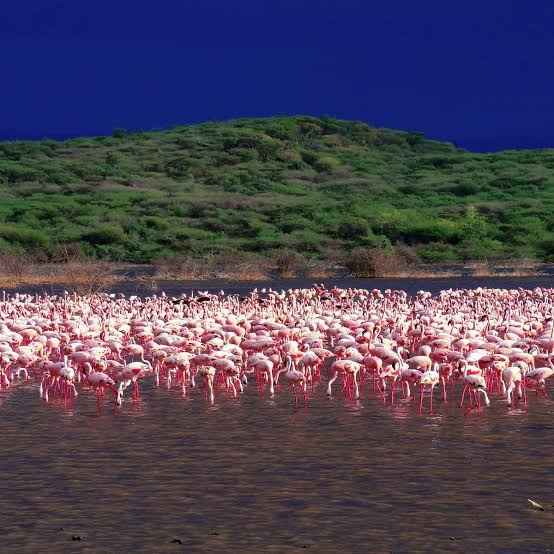
Lake Bogoria is best known internationally as a major feeding ground for the lesser flamingo. The alkaline water supports dense blooms of the blue-green alga Arthrospira (formerly Spirulina), the flamingos' main food. At peak times, hundreds of thousands, and in exceptional years over a million, birds have gathered here, painting the shoreline pink.
Flamingo numbers are not constant. The birds move between Rift Valley lakes such as Nakuru, Elementaita, and Natron, following changes in algal food supply, which in turn depends on water level and chemistry. Rising lake levels and lower salinity in the early 2010s disrupted algal growth and sent many flamingos elsewhere. This mobility is a reminder that these lakes function as a connected system rather than as isolated sites.
Lesser flamingos are listed as Near Threatened, so protecting the whole chain of Rift Valley lakes matters for their survival.
Wildlife and Vegetation
Beyond flamingos, the area supports over 300 recorded bird species, including fish eagles, pelicans, spoonbills, and other waterbirds, plus woodland and raptor species in the surrounding hills.
The reserve is also noted for the greater kudu, a large and elegant antelope that is more easily seen here than in many other Kenyan parks. Other wildlife includes impala, zebra, Grant's gazelle, and klipspringer on rocky slopes, along with baboons and smaller mammals.
The landscape is dominated by dry acacia woodland and scrub, with grassy areas and, around some springs and river mouths, patches of palms and fig trees. Because the lake water is so harsh, there are few fish; the lake's ecology depends mainly on algae and the creatures that feed on it.
Protected Status
The area was gazetted as Lake Bogoria National Reserve in 1973, covering roughly 107 km² including the lake. It is managed by the local county government with support from Kenya Wildlife Service. In 2001 the lake was designated a Ramsar Wetland of International Importance, and in 2011 it was included, together with Lakes Nakuru and Elementaita, in UNESCO's Kenya Lake System in the Great Rift Valley World Heritage Site.
People and History: The Endorois
The land around Lake Bogoria is the ancestral home of the Endorois, a small indigenous community, historically pastoralists, who used the area for grazing, water, sacred sites, and ceremonies. When the game reserve was created in 1973, the Endorois lost access to much of their traditional land, and the dispute became a landmark case.
In 2010 the African Commission on Human and Peoples' Rights ruled that Kenya had violated the community's rights, including rights to property, culture, and development, and recommended restitution and benefit-sharing. The case is widely cited in discussions of indigenous land rights in Africa, and the question of implementation and fair benefit from tourism and geothermal development remains an ongoing conversation.
Visiting Lake Bogoria
How to get there: The reserve is reachable by road from Nakuru or Nairobi through Marigat, with a drive of several hours from the capital. Main entry points include Loboi Gate in the south, Emsos Gate in the north, and Maji Moto Gate on the eastern side.
What to do:
- Watch flamingos from the shoreline, ideally with binoculars
- Walk the hot springs area with a guide
- Go on game drives to look for kudu and other wildlife
- Birdwatching, photography, and camping
- Combine with a trip to nearby Lake Baringo and Lake Nakuru
Practical tips:
- Dry periods and early mornings are best for wildlife and cooler temperatures.
- Bring sun protection, water, and sturdy closed shoes.
- Never step off paths near hot springs, since the crust can break and the water can cause serious burns.
- Check current entry fees, road conditions, and flamingo numbers with the reserve or KWS before travelling, as these change.
Conservation Challenges
Bogoria faces several pressures: shifting lake levels linked to climate variability, which affect salinity and algae; overgrazing and land degradation in surrounding catchments; pollution and sedimentation from upstream; and the need to balance tourism and geothermal development with ecological protection and community rights. Effective management depends on cooperation between conservation agencies, the county government, and the Endorois community.
Conclusion
Lake Bogoria combines geothermal drama, extraordinary birdlife, and deep human history in a single landscape. It is a place of natural wonder, but also a lens on the challenges of conserving fragile ecosystems while respecting the people who have long lived alongside them.