

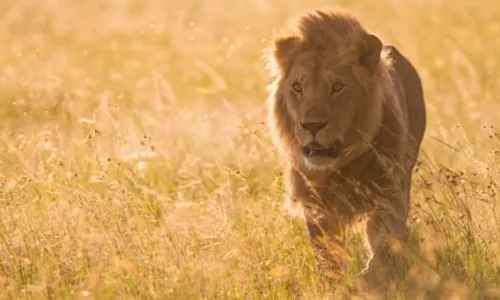
The mist lifts off the wet grass, a termite mound catches the first light, and somewhere nearby a lion is already awake. We want to tell the real story of the Marsh Pride, and why every visitor to Kenya should go and see their home ground.
Where it all began
The story is older than television. Wildlife photographers Jonathan and Angela Scott have followed these lions since 1977, and it was Jonathan who named them the Marsh Pride because their dry season territory centres on Musiara Marsh, a green oasis fed by a permanent spring. In 1982 they published a book about the pride, The Marsh Lions. After BBC in 2008, presenters Jonathan Scott and Simon King, later joined by Maasai guide Jackson Looseyia, followed the pride like a family drama. The lions had names, rivalries and personalities
Scar, Scruffy and the buffalo
In 1998 the pride was led by two males, Scar (the big, majestic older male and the first king in this story; he is the father of Bibi) and Scruffy (Scar's younger who co-led the pride with him) A herd of buffaloes charged into the pride and killed cubs. Scruffy stood his ground against them, while Scar ran. The following year Scruffy was killed by herders. It was an early lesson that life on the Mara is rarely fair, even for kings.
The blond invaders
By the turn of the millennium, two young blond males, Simba (the younger of the pair; he and Blondie took the pride from Scar and led it from about 2000 to 2004) and Blondie (Simba's older coalition partner, who helped him oust Scar), arrived in peak condition. The old Scar was pushed out of the pride. This is the cycle of lion life. A coalition of males rules for a few years until a stronger group challenges it. When a new coalition takes over, the cubs of the old regime are often killed so the lionesses can breed again. It is hard to watch, but it is natural.
Bibi: the lioness who stole hearts
If the Marsh Pride has one heroine, it is Bibi (Scar's daughter.She lost her father's protection when Simba and Blondie took over, ). She was Scar's daughter. In 2003 she was driven out of the pride and had to raise two cubs on her own, without the protection of the other lionesses. Bibi was later accepted back into the pride, and she went on to raise more cubs with Notch (the male who took over from Simba and Blondie around 2004; he was believed to have killed Bibi's earlier cubs), who became the next leading male. For many years the pride's leadership passed on: Simba and Blondie, then Notch and a partner known as Light Male (Notch's coalition partner, who shared the pride with him until about 2007), then Clawed (one of the pair that took over from Notch and Light Male around 2007) and Romeo (Clawed's partner, who led the pride with him until about 2011).
The Three Graces
In 2005 three lionesses called Siena (one of the daughters of Notch's reign), Charm (another of the Three) and Joy (the third of the Three ) were born into the pride, sired by Notch and his partner.
The sad chapter
In December 2015, Bibi died, poisoned along with other members of the pride. They had fed on a carcass that had been laced with poison, a tactic sometimes used when livestock is lost to predators. Two men were charged.
The pride lives on
The lions of Musiara Marsh are still there. The pride has changed and generations have come and gone, but their descendants still hunt, play and rest on the same ground. In 2022 the BBC marked the pride's history with a documentary, Lion: The Rise and Fall of the Marsh Pride, which looks back over more than forty years of their story.
Visiting the Marsh Pride
Where: Musiara Marsh is in the northern part of the Maasai Mara National Reserve, close to Musiara Gate.
Getting there: You can drive from Nairobi in roughly five to six hours, or take a short scheduled flight to a Mara airstrip.
Best time: July to October is the famous Great Migration season, when wildebeest herds cross the Mara River and predators are well fed and active. January to March is quieter and greener, and it is a lovely time to see cubs.
How long: Stay at least three nights in the Mara. Lions are best seen on early morning and late afternoon drives, and a longer stay gives you more chances.
Come and write your own chapter
The Marsh Pride's story is still being written, and you can be part of it. At Yulle Adventures our guides know these plains well and love sharing them. Contact us at info@yulle.co.ke and we will build you a safari itinerary around the Marsh Pride's home.
Karibu Kenya. Welcome to the Mara!