

Kenya's Best Safari Destinations
Picture a lioness crouched in the grass, her eyes locked on a herd of zebra, with the skyscrapers of a capital city glinting behind her. Now picture yourself the next morning, standing on the rim of a volcano as steam curls up from the earth and a lake of pink flamingos shimmers far below. Kenya is a country where both happen within a few days of each other.
Key Takeaways
- The ultimate classic: Masai Mara is the best-known place for big cats and the Great Wildebeest Migration (July to October).
- Icons and surprises: Amboseli offers giant elephants beneath Mount Kilimanjaro, while Nairobi National Park places lions and rhinos beside a capital city.
- Conservation success: Laikipia, home to Ol Pejeta and Lewa, is Kenya’s rhino stronghold, holding about 70% of the country’s black rhinos.
- Unique species: the arid north, including Samburu, is home to the “Special Five”, animals you will not find in the southern parks.
- Mix and match: combining a savannah park with a lake, the coast, or the north gives the most complete wildlife experience.
Kenya’s Top Safari Destinations at a Glance
| Park / Reserve | Best Known For | Landscape and Feel | Best Time to Visit |
| Maasai Mara | Great Migration, big cats, Big Five | Open savannah, dramatic action | July to October |
| Amboseli | Elephants and views of Kilimanjaro | Swamps and open plains | June to October |
| Lake Nakuru | Rhinos and birdlife | Rift Valley lake and woodland | Year-round |
| Laikipia | Black rhinos and wild dogs | Private conservancies on a high plateau | June to October |
| Samburu | The “Special Five” | Hot, dry, rugged and culturally rich | June to October |
| Tsavo East and West | Red elephants, Mzima Springs | Vast, wild and volcanic | June to October |
| Meru | Untamed wilderness (Born Free) | River forests, off the beaten path | July to October |
Masai Mara National Reserve
Masai Mara National Reserve is where you will understand why people fall in love with Africa. Between July and October, more than a million wildebeest, along with zebras and gazelles, gather at the banks of the Mara River. They hesitate, they surge, and then they plunge into water where crocodiles lie waiting. It is raw, chaotic, and impossible to look away from.
Even outside migration season, the Mara is alive with lions, leopards, and cheetahs, and it is one of Africa’s best places to see all of the Big Five. The reserve is a mix of open grassland, savannah woodland and river forest, so predators are present all year. Many camps offer sunrise hot-air balloon flights, so you can watch the plains turn gold from above.
Top Tip: To escape the busiest crowds, stay in one of the private conservancies bordering the reserve, such as Mara North or Naboisho. They limit visitor numbers and allow night drives and guided walks.
Amboseli National Park
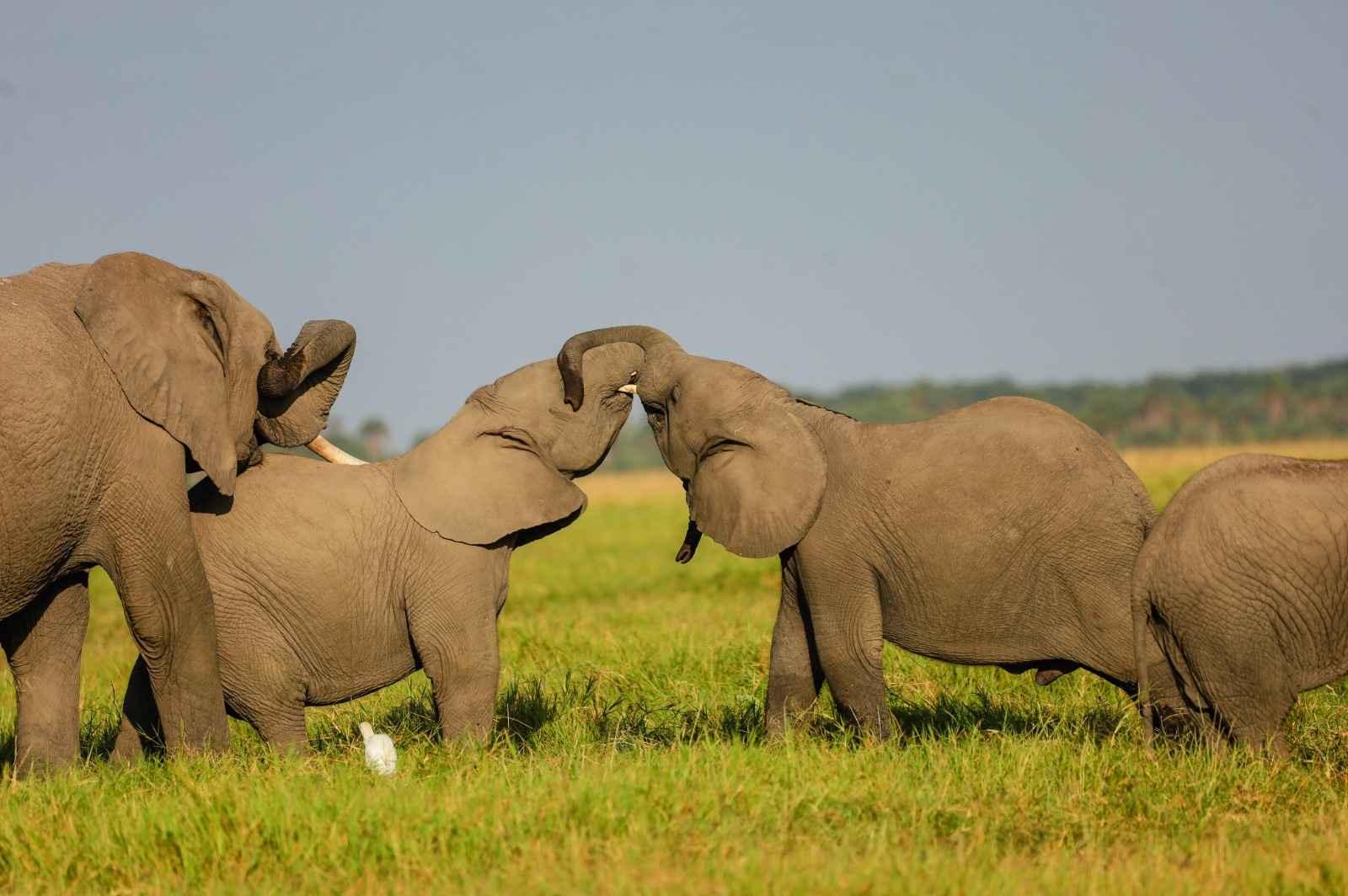
Amboseli National Park offers a view you will never forget. Mount Kilimanjaro, 5,895 metres tall and the highest mountain in Africa, rises just across the border in Tanzania, and in the early morning light its snowy peak floats above the clouds. Beneath it, enormous elephants wade through the swamps, among the most closely studied elephants in the world. The flat, open landscape makes it one of the easiest places in Kenya to photograph elephants with the mountain behind them.
Top Tip: Wake early. The mountain often hides itself by mid-morning.
Diani, Mombasa and the Kenyan Coast
The coast is where the trip softens. Diani Beach stretches for kilometres of powder-white sand and turquoise water on the Indian Ocean, and after days of dusty game drives it feels like a reward. Many travellers finish a safari here, which is why “safari and beach” is such a popular combination.
- Fort Jesus, Mombasa: built by the Portuguese in the 1590s, it still stands over the harbour. Nearby, the narrow lanes of Old Town carry the scent of spices and strong Swahili coffee.
- Haller Park: proof that nature can heal. This barren quarry was reborn as a forest, and hippos, giraffes, and giant tortoises now wander where nothing used to grow. It is a short drive from Mombasa.
Nairobi National Park and the Capital
Nairobi National Park is stranger and more wonderful than it sounds. Established in 1946 as Kenya’s first national park, it is a place where lions and endangered black rhinos live within sight of skyscrapers and passing aircraft. Because it is so close to the city, it works well as a half-day safari on your first or last day in Kenya. Back in the city, do not miss:
- Giraffe Centre: feed a Rothschild’s giraffe from a raised platform, its long purple tongue curling around the pellets in your hand.
- Sheldrick Elephant Orphanage: orphaned baby elephants charge in for their milk bottles. Visitors are welcome for one hour each day, so plan around the opening time.
- Karen Blixen Museum: the farmhouse that inspired Out of Africa, the memoir by the Danish author Karen Blixen.
- Karura Forest: a vast green escape with waterfalls, caves, and bike trails right inside the city.
The Rift Valley and Beyond
The Great Rift Valley is a huge trench that cuts through Kenya from north to south, and it is dotted with lakes, volcanoes and parks. It opens up with one great destination after another:
- Lake Nakuru National Park is a rhino sanctuary where black and white rhinos graze beneath yellow-barked acacia trees. It is also famous for its birdlife, with over 400 species recorded. Flamingo numbers rise and fall with the water level, but when the conditions are right, the whole shoreline turns pink.
- Lake Naivasha and Hell’s Gate National Park make a perfect pair. Naivasha is a freshwater lake alive with hippos and fish eagles, and on Crescent Island you can walk among giraffes and zebras on foot, since there are no predators. At Hell’s Gate, you can cycle between towering red cliffs, pass the rock spire of Fischer’s Tower, and ride into a gorge carved by ancient volcanic floods.
- Lake Elmenteita is a quiet soda lake where pelicans and flamingos gather beneath the hills known as the Sleeping Warrior, beside the Soysambu Conservancy.
- Mount Longonot National Park is for those who like to earn their views. A steep climb to 2,776 metres brings you to the rim of a crater, where steam rises from vents and the Rift Valley spreads out below.
- Tsavo East and Tsavo West National Parks together form one of the largest protected areas in Africa. The elephants here are stained a deep red by the iron-rich soil. In Tsavo West, Mzima Springs has an underwater viewing chamber where you can watch hippos walk along the bottom of a crystal-clear pool, and the black Shetani lava flow looks like the surface of another planet. This is also the land where the famous man-eating lions of Tsavo terrorised railway workers in 1898.
- Samburu, Buffalo Springs, and Shaba National Reserves lie along the Ewaso Nyiro River in Kenya’s hot, dry north. The river is a lifeline for wildlife, including a large population of Nile crocodiles. The reserves are home to the “Special Five”: Grevy’s zebra, reticulated giraffe, Somali ostrich, the gerenuk (an antelope that stands on its hind legs to reach leaves), and the Beisa oryx. You will not find these animals in the south.
Top Tip: Lake Nakuru is small and easy to reach, so it works well as a day trip or a one-to-two-night stopover on the way to the Mara. At Samburu, make time for a cultural visit to a Samburu village to learn about local traditions.
Wild Places for the Curious Traveler
Beyond the famous parks, Kenya becomes quieter, stranger, and in many ways more rewarding. These places see fewer visitors, and several of them offer experiences you cannot have in the main parks.
Laikipia, Mount Kenya and the Aberdares
- Ol Pejeta Conservancy sits right on the equator and holds a heartbreaking distinction. It is home to the last two northern white rhinos on Earth, a mother and daughter named Najin and Fatu, protected around the clock by armed rangers. Standing near them is a humbling experience. The conservancy also shelters a chimpanzee sanctuary.
- Lewa Wildlife Conservancy protects rhinos and the world’s largest population of Grevy’s zebras.
- The wider Laikipia plateau is a patchwork of private conservancies where you can go on night drives, walking safaris, and search for wild dogs. It is also one of the best places in Kenya for horse riding and camel trekking.
- Mount Kenya, Africa’s second-highest mountain at 5,199 metres, keeps real glaciers on the equator, and trekkers can reach Point Lenana without technical climbing.
- Aberdares National Park: waterfalls drop nearly 300 metres through misty highlands, and at treetop lodges like Treetops, elephants and buffalo come to the waterhole below your window as night falls.
The Coast, Beyond the Beaches
- Watamu and Malindi offer turtle conservation, a protected marine park, and the Gede Ruins, a 12th-century Swahili town left abandoned in the forest.
- Arabuko Sokoke Forest is the largest remaining stretch of coastal forest in East Africa, home to the tiny golden-rumped elephant shrew and rare birds found almost nowhere else.
- Kisite-Mpunguti Marine Park and Wasini Island, off Shimoni, offer dolphin swims, snorkelling over coral gardens, and a fresh seafood lunch in a Swahili village.
- Shimba Hills National Reserve is the only place in Kenya to see sable antelope, with a waterfall hidden in coastal rainforest.
Lakes, Birds and the West
- Lake Bogoria has around 200 geysers and hot springs bubbling beside a shoreline lined with flamingos.
- Lake Baringo is a freshwater lake filled with hippos, crocodiles, and more than 400 species of birds.
- Lake Magadi glows with white soda crusts, hot springs, and pink birdlife.
- Kakamega Forest is the last remnant of the great equatorial rainforest that once stretched across Africa, and red-tailed monkeys and hundreds of bird species fill its canopy.
- Mount Elgon National Park has caves where elephants dig out salt from the walls with their tusks.
- Saiwa Swamp National Park, one of Kenya’s smallest parks, lets you walk its boardwalks in search of the rare, water-loving sitatunga antelope.
- Around Lake Victoria: Kisumu offers some of the finest sunsets in the country. Ruma National Park is the only place in Kenya where you can see roan antelope. Rusinga Island is where scientists found an ape skull around 18 million years old. Kit Mikayi is a sacred stack of balancing boulders that seems to defy gravity.
The Far Edge of Kenya
- Lake Turkana, the “Jade Sea,” is the world’s largest permanent desert lake, glowing blue-green against black volcanic rock. Its waters shelter large numbers of Nile crocodiles, especially around Central Island.
- Sibiloi National Park and Koobi Fora, on the eastern shore, are some of the richest early human fossil sites on the planet, which is why this region is known as the Cradle of Mankind.
- Marsabit National Park is a misty forest rising out of the northern desert, dotted with crater lakes and remembered for its legendary giant-tusked elephants.
- Meru National Park and Kora National Park are green, quiet, and wild, and this is the land where Joy and George Adamson raised Elsa the lioness, whose story became Born Free.
- The Chyulu Hills are among the youngest volcanic mountains on Earth, with vast lava tubes running underground.
- Thimlich Ohinga, deep in the southwest, is a mysterious stone fortress, its dry-stone walls built around 500 years ago and still standing without a drop of mortar.
Top Tip: Meru is hotter and more humid than the Mara, so the grass is tall and wildlife can hide. Book an experienced guide to help track animals.
Sample 7-Day Kenya Safari Itinerary
| Day | Destination | What You Will Do |
| Day 1 | Nairobi | Arrive and settle in. Visit the Giraffe Centre and the one-hour daily visit at the Sheldrick Elephant Orphanage. |
| Day 2 | Nairobi to Lake Naivasha | Drive into the Rift Valley. Take a boat ride among the hippos and walk among giraffes and zebras on Crescent Island. |
| Day 3 | Naivasha to Lake Nakuru | Cycle through Hell’s Gate in the morning, then enjoy an afternoon game drive in Lake Nakuru for rhinos, flamingos, and birdlife. |
| Day 4 | Nakuru to Maasai Mara | A long road day (roughly 5 to 6 hours), finishing with an evening game drive in the Mara. |
| Day 5 | Maasai Mara | Full-day game drives for big cats, with an optional sunrise balloon flight. Watch for river crossings from July to October. |
| Day 6 | Maasai Mara to Nairobi | Morning game drive, then return to Nairobi by scheduled flight or by road. |
| Day 7 | Nairobi | Visit the Karen Blixen Museum or Karura Forest before your departure. |
Easy add-ons:
- Amboseli (2 extra days): elephants and sunrise views of Kilimanjaro.
- Kenyan coast (3 to 4 extra days): Diani Beach, Fort Jesus in Mombasa, and Haller Park.
- The north (3 extra days): Samburu for the “Special Five” or Laikipia for rhinos and walking safaris.
Quick Planning Tips
- Best time to go: the long dry season from June to October is generally best, as the bush is thinner and animals gather at water sources. This is also when the Great Migration reaches the Mara.
- How long to stay: 7 to 10 days, split across two or three contrasting regions, lets you enjoy Kenya without rushing.
- Parks versus conservancies: national parks and reserves are government-run, while conservancies are privately managed, limit visitor numbers, and permit night drives and walking safaris.
- Fences: most major parks, including the Mara, are unfenced, so wildlife roams freely. Some rhino sanctuaries, such as parts of Lake Nakuru and Ol Pejeta, are fenced to protect endangered species.
- Safety: Kenya has a well-established safari industry. Stay at reputable lodges and always follow your guide’s instructions, especially around wildlife.
Ready to explore Kenya ? Contact us at Yulle Adventures for itineraries and quotations.