

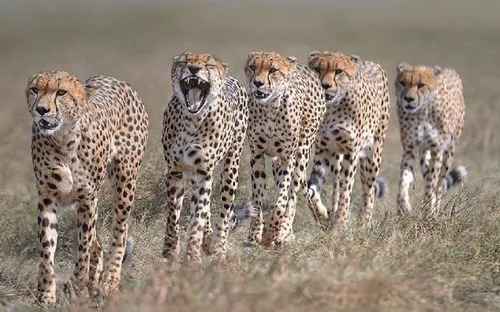
Five strangers on the plains
At the end of 2016, five young male cheetahs slipped out of the Naboisho conservancy and walked into the Maasai Mara National Reserve. Nobody could have guessed what they would become. Cheetahs are loners by nature, and a group of five was highly unusual. Yet here they were, sitting shoulder to shoulder in the golden grass and staring at grazing antelope. Guides and photographers named them Tano Bora, which means "the Magnificent Five" in the local Maa language. Others called them the Fast Five.
Brothers, but not all.
Most people assumed they were five brothers. The truth was messier. Only two are known to have come from the same litter, and one was a lone cheetah who joined the others despite having no family tie. Some reports say the group was made up of three brothers and two others, so the exact relationships are still debated. What mattered was the bond, and it held for years.
Meet the five.
Olpadan [ the leader and master hunter] led the group for almost three and a half years. His name means a sharp marksman in Maa.
Olarishani [the peacemaker] stepped in when coalition-mates were attacked. His name means "judge".
Leboo [ the loyal follower] joined every hunt and fight. His name means "the one who is always within a group".
Olonyok [ the underdog who became leader] was the lowest in rank and often bullied. His name means someone who works hard for better results.
Winda [the hunter, related to Olonyok and Leboo] has a Swahili name meaning "hunter". He later co-led the group
The hunters
Together they were unlike any cheetahs people had seen. They hunted unusually large prey and showed group behavior that is rarely seen in cheetahs. A single cheetah usually takes small gazelles. Five working together could bring down a wildebeest.They cooperated in everything apart from breeding. When it came to females, each male mated separately. One scene stayed with the people who watched it: a mother, Nora, with her two-month-old daughter, suddenly facing all five males (the largest known male coalition in the Maasai Mara). Her cub's life depended on what they did next.
The river
The picture that made them world-famous was of four of them at the edge of the Talek River. The photograph showed four of the five cheetahs battling a raging river. They crossed together, soaked and grimacing, and the image went around the world. Millions saw it, and the Tano Bora became the Mara's most photographed cats. Their story appeared in global films, documentaries and conservation magazines.
The break
Then, after about five years, the unity cracked. Four of the cheetahs turned on a member of their own coalition, Olpadan, and killed him in a fight over territory. Wildlife lovers were shocked. How could brothers in arms do that?The loss did not stop there. Barely three weeks after the group had expelled and killed one of their own, a second member died. His name was Olarishani, and he died of bite injuries. The three that remained became known as the Tatu Bora and they were seen together between the reserve and the northern conservancies.
And then there were two
In 2022 came more bad news. Leboo died, probably killed by lions, leaving the famous coalition reduced to two. The Tano Bora no longer rule the plains, but their legacy remains. Their images taught the world about cheetah behaviour and about the animals' vulnerability to habitat loss and climate change. They showed that cheetahs could be social, strategic and loyal, and that even the strongest bonds can break under pressure.On the Mara's open plains, cheetahs still stand on termite mounds at dawn, scanning for prey, and the next famous coalition may already be growing up.
Come explore the land of the Tano Bora cheetahs with Yulle Adventures. Contact us at info@yulle.co.ke for blogs and itineries as well as guided safaris.