

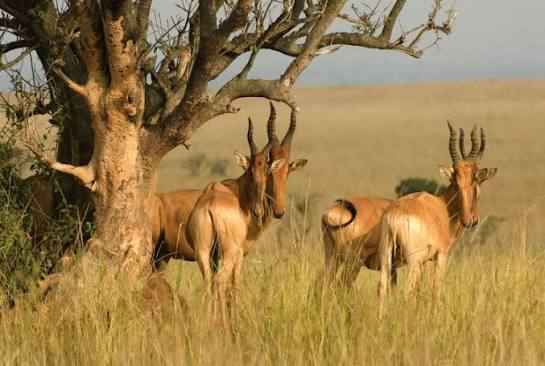
Ruma National Park: Last Retreat of the Roan Antelope
A Yulle Adventures guide to the Lambwe Valley's best-kept secret
Ask most travellers to name Kenya's great safari destinations and the same handful of names come up: the Maasai Mara, Amboseli, Tsavo. Few will mention a quiet valley in Homa Bay County, just east of Lake Victoria, where the grassland rolls out beneath volcanic hills and you can drive for hours without meeting another vehicle. That valley is Ruma National Park, and it deserves a place on your list.
Ruma is small, remote and gloriously uncrowded. It is also the only place in Kenya where the endangered roan antelope still lives, which makes it one of the most important protected areas in the country. Add a strong population of Rothschild's giraffe, plenty of white rhino, more than 400 bird species and a landscape layered with local legend, and you have a destination that rewards the curious traveller.
At Yulle Adventures we love places that make you slow down and look properly, and Ruma is exactly that kind of place. This guide covers what makes it special, what you can expect to see, how to get there and how to plan a trip that does the park justice.
Where Ruma Sits
Ruma National Park lies in Homa Bay County in western Kenya, roughly ten kilometres east of Lake Victoria. It covers about 120 square kilometres on the flat floor of the Lambwe River Valley, a seasonally watered basin that gives the park its open, spacious feel. The Kanyamwa Escarpment rises to the south-east, the volcanic plugs of the Ruri Hills stand to the north, and the Gwasi Hills form a backdrop on the horizon.
The result is a mosaic of habitats packed into a modest area: rolling savannah, riverine woodland, acacia stands, open grassy plains and dramatic cliffs. Much of the ground is black cotton soil, which turns thick and sticky after rain and cracks into a patchwork in the dry months. Photographers adore the place for exactly this variety. A tower of giraffes silhouetted against the hills in late afternoon light is almost the signature image of Ruma.
The park's scale is part of its charm. Game drive circuits are manageable, wildlife is rarely far away, and because Ruma is among the least visited parks in Kenya, sightings tend to be unhurried and entirely your own. There are no minibus queues around a lone leopard here. There is just you, the grass and the wind.
A Valley With a Long Memory
Ruma's story begins in 1966, when the area was set aside as the Lambwe Valley Game Reserve to protect a population of roan antelope found nowhere else in Kenya. In 1983 it was upgraded to a national park and renamed Ruma at the request of the local Luo community. Accounts differ on the details, but the name is tied to the legend of Gor Mahia, a feared and respected figure said to have lived around the valley and to have frequented the Kanyamwa Escarpment. Football fans will recognise the name: one of Kenya's most famous clubs, Gor Mahia FC, is named after him.
The valley has a darker past too. For decades the Lambwe Valley was infested with tsetse flies, which carry sleeping sickness in people and nagana in livestock. That kept settlers and herders out and, ironically, kept wildlife in. According to local accounts, colonial authorities sent people who resisted their rule into the valley as punishment. The Kolang'o picnic site is remembered as part of an escape route used by Kalenjin and Nandi people who were forced there. Stopping at Kolang'o, you are standing somewhere that carries real weight.
Tsetse control began in earnest in the 1960s and people gradually moved into the surrounding land. The park's survival has never been guaranteed. Plans to hand the valley over to farming were resisted decades ago, and in more recent years politicians have called for the park to be degazetted over crop damage by wildlife. Today Ruma is managed by the Kenya Wildlife Service (KWS), fenced with an electric barrier meant to keep animals in and livestock out, and supported by community groups such as the Ruma Site Support Group, a partner of Nature Kenya.
The Roan Antelope: Ruma's Reason for Being
The roan antelope is the heart of Ruma. It is one of Africa's largest antelope and is built more like a horse than a dainty gazelle, with a sandy-grey coat, a boldly marked face, long tufted ears and sweeping, backward-curved horns. One reviewer described it as more horse than antelope, and once you see a roan grazing out in the open grass, you understand why.
Roan once roamed more widely in Kenya, but the population has collapsed. Reports from the late 1970s put the national total at around 300, with the largest group, roughly 200 animals, in the Lambwe Valley. A count of 202 at Ruma in 1969 is often quoted. Since then, tsetse and disease, habitat change and poaching have taken a heavy toll.
Today the surviving herd lives in a fenced, predator-proof sanctuary of a few square kilometres near the Nyatoto Gate. Counts vary by source and by year. The KWS Director General has described around 27 animals, while older reports mention anything from a dozen to about forty. The exact figure matters less than the message: this is a species hanging on by a thread. KWS launched a roan antelope recovery plan in 2020, and events such as the Roan Antelope Half Marathon, held in the park, help raise awareness and funds for its protection.
Seeing roan is never guaranteed, because the animals are carefully managed inside the sanctuary, but park rangers know where to look. Visitors have reported spotting a few in a couple of hours. Bring binoculars, bring patience, and treat every sighting as the privilege it is.
Giraffe, Rhino and the Supporting Cast
While the roan steals the headlines, Ruma's other residents are the reason many visitors fall in love with the park. It is widely regarded as a stronghold for the Rothschild's giraffe, one of the most threatened giraffe subspecies, and herds are easy to find browsing the acacias with the Gwasi Hills behind them. The Twiga picnic site, in the middle of the park, is a wonderful place to unpack a snack and watch them go about their day.
White rhino, reintroduced to the park, are another highlight. Several visitors have been surprised by just how abundant they are, scattered across the grassy plains. Black rhino are present too, but they are shy and seldom seen, occasionally turning up near the airstrip. Buffalo, Burchell's zebra, topi, impala, defassa waterbuck, warthog and olive baboons round out the larger mammals.
Ruma is also a park for small antelope. Oribi, the tiny, delicate grassland antelope that gives the park part of its nickname, can be found here, along with bohor reedbuck and both Jackson's and Lelwel hartebeest. Keep an eye out for servals and honey badgers, and know that leopard and spotted hyena live here but are secretive and rarely seen. Lion and elephant are not part of the Ruma story, which is partly why the park feels so calm.
Reptile lovers will have plenty to look for as well, including pythons, cobras and puff adders. They are best admired from a safe distance, which is a good reason to stay in your vehicle except at designated stops and to watch where you step when you do get out.
A Birdwatcher's Park
More than 400 bird species have been recorded in Ruma, and the park is recognised as an Important Bird Area. Raptors, bustards, rollers, weavers and waterbirds are all part of the cast, and African fish eagles perch in the riverine trees. Ruma is also known for being the one protected area in Kenya where the blue swallow, a scarce migrant, is regularly recorded, and it has delivered sightings of a rare cisticola once feared lost to the country.
Because visitor numbers are so low, birding here can be done in near-solitude. Early mornings along the valley floor and quiet afternoons by the woodland edges are the best times, and even beginners will tick off a satisfying list.
Things to Do in Ruma
- Game drives. A network of tracks crosses the valley, and a guide from the park will help you read the landscape and find the animals. KWS charges a fee for guides, so budget for one.
- Roan antelope viewing. Ask the rangers to take you to the sanctuary near Nyatoto Gate and give yourself time to watch quietly.
- Birdwatching. Bring a field guide and binoculars and let the morning light do the rest.
- Picnics with a view. Twiga picnic site puts you in the middle of giraffe country, while Kolang'o offers both scenery and history.
- Camping and sundowners. Nights under a huge western Kenyan sky, with the sounds of the valley around you, are a highlight in themselves.
- Bike safaris. Cycling experiences inside the park have been promoted in recent years. Ask KWS or a local operator about current availability and safety arrangements before you plan around it.
- Running with a purpose. The Roan Antelope Half Marathon brings athletes, conservationists and local communities together in the park for a cause that has real conservation value.
Where to Stay
Accommodation inside Ruma is simple and budget-friendly, which suits a park that is all about the wild rather than the thread count. Oribi Guest House is a self-catering guesthouse set on the Kanyamwa Escarpment, with views over the valley. For campers there are two options: Nyati, a special campsite, and Fig Tree, a public campsite that has long been a favourite with backpackers.
There is no lodge or restaurant inside the park, so bring your own food, water and cooking supplies, ideally stocked up in Homa Bay before you set off. If you prefer more comfort, base yourself in Homa Bay or Mbita and make Ruma a day trip, or consider Rusinga Island Lodge, about thirty kilometres away on Lake Victoria.
Getting There
Ruma is about 425 kilometres west of Nairobi and roughly 140 kilometres from Kisumu. The park has two main gates, Kamato (the main entrance) and Nyatoto, both about 42 kilometres and a drive of around 30 minutes to an hour from Homa Bay town, depending on conditions.
From Homa Bay, take the C20 tarmac road towards Rongo. After about ten kilometres, branch right at Rodi Kopany and continue roughly twenty kilometres to Mirogi, then follow the signs along a murram road to the gate. Another route runs from Kisumu to Lwanda K'Otieno, across Lake Victoria by ferry to Mbita, and then about twenty kilometres to Nyatoto Gate.
If you prefer to fly, the nearest major airport is Kisumu, and small airstrips serve Homa Bay and Rusinga Island. From there you will need a private vehicle or taxi. A 4x4 is strongly recommended, since parts of the road network can become impassable after rain. The park is open from 6:00 am to 7:00 pm daily, with no entry after 6:15 pm, and visitors may not enter on foot.
When to Visit
Ruma welcomes visitors year-round, and the climate is hot and humid. The long rains fall from April to June and the short rains from October to December. For the easiest wildlife viewing and the best road conditions, aim for the drier windows of June to October and January to February, when animals gather in the open and the tracks are firmer.
The rainy seasons have their own appeal. The valley turns a lush green, birdlife is at its most vibrant, and the crowds, already tiny, vanish completely. Just keep in mind that the black cotton soil can make driving difficult, so check conditions with KWS before you commit.
Practical Tips for Your Visit
- Check current fees before you travel. KWS introduced a new fee structure in October 2025, and older figures still circulating online do not always match. Confirm rates on the official KWS website and pay through the KWS eCitizen platform, which accepts M-Pesa and cards.
- Carry original ID or your passport. Remote gates may not accept digital copies.
- Bring a full tank of fuel, spare water, food and a basic first-aid kit. Facilities are limited.
- Pack for heat and humidity: sunscreen, a hat, light long sleeves, closed shoes and good insect repellent.
- Ask your doctor about malaria prophylaxis, since the park is close to Lake Victoria and mosquitoes are part of the experience.
- Bring binoculars. Roan antelope and small birds are far more rewarding when you can see them up close.
- Follow ranger guidance, keep a respectful distance from wildlife and carry out everything you carry in.
A Simple Two-Day Plan
If you can only spare a weekend, here is how we would shape it. Arrive in Homa Bay the day before, stock up on food, water and fuel, and settle in early. On day one, enter the park as the gates open at 6:00 am, when the animals are most active and the light is soft. Spend the morning on a guided drive across the valley floor, then head to the roan sanctuary near Nyatoto Gate with your binoculars.
Take a long picnic lunch at Twiga, watching giraffe wander past, and use the heat of the afternoon to visit Kolang'o and learn its story. Return to camp or the guesthouse for sundowners. On day two, repeat a dawn drive in a different part of the park, focusing on birds and rhino, before the long drive home. Two unhurried days are plenty to feel the rhythm of the valley.
Make It Part of a Western Kenya Adventure
Ruma is a natural anchor for a wider journey through the west of the country. Travellers often combine it with Kakamega Forest, Mount Elgon and Saiwa Swamp for a trip that trades the famous crowds for rainforest, highland and wetland wilderness. Closer to Ruma, the shores of Lake Victoria, the fishing communities around Mbita and the island life of Rusinga make easy and memorable additions.
There is another reason to go sooner rather than later. The Kenyan government has spoken of developing Ruma into a flagship attraction on the Western Tourism Circuit. Better facilities and greater awareness would be welcome news for conservation, but the quiet that makes the park so special today may not last forever.
Why Ruma Matters
Ruma is not the biggest park in Kenya, and it does not promise the Big Five or a dramatic river crossing. What it offers is something increasingly rare: a place where nature has room to breathe, where one of Africa's most striking antelope clings on, and where your visit directly supports the people and rangers working to keep it there.
Every entry fee, every night in the campsite and every conversation with a ranger helps the case for protecting the Lambwe Valley. If you are ready to trade the crowds for silence, and a long list of ticked animals for a handful of truly memorable encounters, Ruma is waiting.
Ready to plan your trip? Talk to the team at Yulle Adventures and let us help you build a journey to Kenya's last retreat of the roan antelope.