

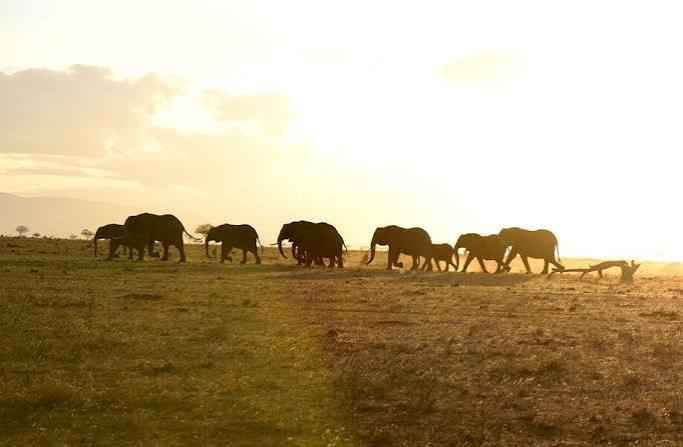
Mwaluganje Elephant Sanctuary: Where Coastal Giants Still Roam
A community-owned corner of the Shimba Hills ecosystem, and one of the most rewarding wildlife stops on Kenya's south coast
By Yulle Adventures| Kenya Travel Guide
There is a particular kind of silence that falls over a safari vehicle when an elephant steps out of the trees. Engines are cut, cameras are lowered, and for a few seconds nobody says a word. On Kenya's south coast, that silence is available a short drive from the white sand of Diani and the old streets of Mombasa, in a place most visitors never hear about: the Mwaluganje Elephant Sanctuary.
Most first-time travellers to Kenya build their plans around the famous names: the Maasai Mara, Amboseli, Tsavo. The coast, meanwhile, gets filed under "beach". Mwaluganje quietly breaks that rule. It is a wild, forested, cliff-edged landscape in Kwale County where elephants still follow routes their ancestors walked long before there were farms, fences or tour vans. It is also one of the earliest examples in Kenya of something bigger than a wildlife destination: a place where the people living beside the animals chose to become their guardians.
At Yulle Adventures we love places that give travellers more than a photograph, and Mwaluganje is exactly that. In this guide we look at how the sanctuary came to be, why its community-owned model matters, what you can expect to see, and how to plan a visit that is good for you and good for the elephants.
Where the Coast Meets the Wild
Mwaluganje lies in Kwale County, roughly 45 kilometres south-west of Mombasa. It sits directly against the northern edge of the Shimba Hills National Reserve and stretches north towards the Mwaluganje Forest Reserve, forming a green link between the two. The scenery is anything but flat coastal plain. Steep ridges, rocky escarpments, forested hills and the valley of the Cha Shimba River give the sanctuary a dramatic, almost lost-world character, with dry baobab bushland on the lower slopes and moist forest where the streams run.
Getting there is refreshingly simple. From Mombasa island you take the Likoni ferry and join the Lunga Lunga road heading south. After about 18 kilometres you turn right at Kombani Junction and continue some 16 kilometres to Kwale Town, where signs lead to the sanctuary's ticketing office. From the beach hotels of Diani it is a shorter hop inland, and the sanctuary itself describes the journey from the South Coast beaches as roughly half an hour. That makes Mwaluganje one of the easiest wildlife outings on the whole coast: you can have breakfast within sight of the Indian Ocean and be watching elephants before the heat of the day sets in.
A quick note on numbers. Published figures for the sanctuary's size vary a good deal between sources, from a few tens of square kilometres to around 60,000 acres, depending on whether surrounding forest and buffer land is counted. What nobody disputes is its purpose. Mwaluganje is a corridor, and corridors matter far more than their acreage suggests.
A Sanctuary Born from Conflict
To understand Mwaluganje, you have to understand the problem it was created to solve. The Shimba Hills area holds a substantial elephant population, and by the late twentieth century those elephants and the growing human population around them were competing for the same land. The animals travelled, as they always had, between the Shimba Hills and the Mwaluganje forest to the north, and onward towards the vast Tsavo ecosystem inland. But that old route now ran straight through farms. A herd crossing a smallholder's field can undo a season's work in a single night, and the result was crop loss, fear, retaliation and, too often, dead elephants.
The answer that emerged in the early 1990s was unusual for its time. Instead of simply fencing animals into a park or pushing people out, the Kenya Wildlife Service worked with the local community, landowners and county authorities, supported by partners including USAID, the Born Free Foundation and the Eden Wildlife Trust, to set aside a protected corridor. Elephants could move safely through it, and the families who owned the land would be rewarded for hosting them. The sanctuary was formally opened in 1995 and is widely described as Kenya's first community wildlife sanctuary.
Behind that short history is an act of real trust. More than two hundred families agreed to lease their land to a community-based trust and to stop farming a habitat that elephants needed. In return they became stakeholders in something that depended on visitors, donors and the animals themselves surviving. It was a bet that elephants could be worth more to their neighbours as partners than as pests, and nearly three decades later that bet still shapes everything about the place.
The Community Behind the Conservation
Today the sanctuary is run by the Golini-Mwaluganje Community Wildlife Conservation Ltd, an association of the landowners themselves. It has an elected board, with the Kenya Wildlife Service, the Kenya Forest Service and Kwale County taking part as associate members, while a team of wardens and community rangers handles daily operations and patrols.
The money is meant to flow back to the people who made the sanctuary possible: lease payments to the families who gave up farmland, jobs for rangers and guides, and income from the gate fees you pay when you visit. Over the years the sanctuary has also supported small enterprises designed to reduce its dependence on tourism alone, including beekeeping for honey, butterfly breeding and, most famously, paper made from elephant dung.
Yes, really. Elephant dung is rich in plant fibre, and once it has been cleaned and processed it makes handsome, textured handmade paper. A notebook or greeting card made this way is one of the more memorable souvenirs you can bring home from the Kenyan coast, and buying one puts money directly into the hands of the community protecting the animals.
For travellers, this is what separates Mwaluganje from a typical wildlife stop. Your entrance fee is not a transaction with a distant authority. It is a vote, cast in shillings, for a model in which local people have a direct, practical reason to keep elephants alive. When a place works because the neighbours want it to, the animals tend to be better off, and so does the experience.
Meeting the Elephants
The main attraction is, of course, the elephants. Estimates commonly put the resident population at around 150 animals, and they move freely through the sanctuary and on into the Shimba Hills. These are wild, free-ranging elephants rather than habituated show animals, so every encounter is unscripted. You may spend an hour watching a family feed quietly in the shade, or you may catch only a glimpse of a grey back moving through the trees. Both are part of the deal.
The terrain shapes how you see them. In dense forest and along the river valleys, elephants can appear suddenly, a grey shoulder in the green that resolves into a matriarch with a calf pressed against her leg and the rest of the family drifting behind at their unhurried pace. In more open stretches and around water you may get longer, clearer views, especially in the cooler hours of early morning and late afternoon, when the animals are most active and the light is at its softest.
Try to watch the behaviour as well as the animals. Elephants communicate constantly, through the slow flap of an ear, a trunk lifted to test the air, a low rumble that human ears barely register. Calves practise using their trunks and get things wrong. Older females decide where the family goes next, and the rest follow. A good guide will help you read these signals and will keep a respectful distance, because the golden rule of elephant viewing is simple: if an animal changes what it is doing because of your vehicle, you are too close.
Photographers should keep context in mind. The most striking images at Mwaluganje are often not tight portraits but wider frames: elephants set against steep forested ridges, or crossing a river valley with the hills rising behind them. This is a coastal elephant landscape, and it looks nothing like the open, dusty plains of Amboseli. That difference is a large part of its charm.
More Than Elephants
It would be a mistake to treat Mwaluganje as an elephant-only destination. The landscape is a major part of the appeal, and several features are worth building into your day.
Ancient cycads
The sanctuary was originally conceived to protect not only elephants but also Encephalartos cycads, fan-shaped plants whose lineage stretches back some 300 million years, long before the dinosaurs. Driving or walking among them gives the forest a distinctly prehistoric feel, and it is a rare chance to see such ancient plants growing wild.
The Cha Shimba River valley
The river carves through the heart of the sanctuary, and its banks support lush riverine forest and a good variety of birdlife. If you enjoy birdwatching, bring binoculars. Raptors such as the crowned eagle are among the highlights, and the forest edges reward patient looking.
God's Bridge and Time Rock
Two natural landmarks are among the best-known sights inside the sanctuary. God's Bridge is a striking rock formation spanning the gorge, and Time Rock is a dramatic outcrop that makes a fine stop for photographs. Both are good reasons to climb out of the vehicle, with your guide's agreement, and stretch your legs.
Viewpoints and wider wildlife
Drive or hike to the elevated viewpoints and you are rewarded with sweeping panoramas over the Shimba Hills and the countryside beyond. Other wildlife lives here too, and the adjoining Shimba Hills National Reserve is especially famous for its sable antelope, a species found nowhere else in Kenya. Sightings of smaller animals are less predictable than the elephants, which is part of why a day here feels like a genuine walk in the wild rather than a checklist.
A Sanctuary Under Pressure, and a Recent Revival
No honest portrait of Mwaluganje would skip the difficult parts. Community conservation is hard, and the sanctuary has gone through lean periods. Visitor income has at times dropped sharply, and the landowners who lease their land still need to be paid whether or not tourists arrive. Human-elephant conflict has not vanished either. News reports in recent years have described herds leaving the protected area and raiding crops in nearby villages, a reminder that fences and corridors reduce conflict but cannot eliminate it.
What has kept the sanctuary alive is sustained support. The Sheldrick Wildlife Trust has continued to compensate landowners during periods when visitor income fell, and in 2023 and 2024 it re-fenced the wider ecosystem, covering both the sanctuary and the Shimba Hills National Reserve, over a length of about 117 kilometres. Since early 2025, the Kenya Wildlife Service has also been moving herbivores, mainly zebras, into the neighbouring reserve. Because there is no fence between the two areas, those animals can move freely, and Mwaluganje is expected to benefit over time. Recent accounts also describe rehabilitated hiking trails and repaired roads.
The result is a place on the upswing: lesser known, less crowded than Kenya's headline parks, and increasingly well cared for. For a traveller, that is a rare combination, and a good argument for visiting sooner rather than later.
Planning Your Visit
Mwaluganje works beautifully as a day trip from Mombasa or Diani, and it slots easily into a wider coastal itinerary. Here is what to know before you go.
- Opening hours: the sanctuary is listed as open from 6:00 am to 7:00 pm. Arriving early gives you the best chance of seeing elephants active in the cooler hours.
- Entrance fees: recent 2026 listings show adult rates of KES 200 per person per day for citizens, KES 500 for residents and KES 1,000 for non-residents. Fees change, so confirm current rates before you travel.
- Getting around: a vehicle with good ground clearance and a local ranger guide is the best way to explore the tracks, and a guide makes a real difference to how much you see and understand.
- Best time to go: the drier months, generally January to March and June to October, make for easier driving and more comfortable viewing. The long rains of April and May can leave tracks muddy, though the forest is at its greenest.
- What to bring: sturdy closed shoes, a sun hat, sunscreen, plenty of drinking water, insect repellent, binoculars and a camera with a decent zoom. Neutral, light clothing is best.
- Cash: carry some small notes for local crafts, elephant-dung paper products and tips for guides.
Most visitors treat Mwaluganje as a half-day or full-day excursion, but it also pairs naturally with its neighbour. The Shimba Hills National Reserve is just next door and offers rolling grassland, forest and the sable antelope mentioned above. If you have more time, the sanctuary sits on the old elephant route towards Tsavo, so it makes a thoughtful warm-up or finale to a longer safari that includes Tsavo East and West.
Visiting Responsibly
A sanctuary like this thrives on good visitor behaviour. A few habits make every trip better for everyone, the elephants included.
- Keep your distance and never try to approach, startle or feed an elephant. Let your guide decide when to move closer or back away.
- Stay quiet. Loud voices and music disturb wildlife and spoil the experience for other visitors.
- Take your litter with you, especially plastic. Elephants and other animals can be harmed by discarded waste.
- Spend money locally. Buying crafts, honey or dung paper, and tipping guides and rangers, strengthens the case for conservation among the people who live alongside the wildlife.
- Respect the community. Ask before photographing people, and treat the sanctuary as what it is: someone's home and livelihood, not only a tourist attraction.
Why Mwaluganje Deserves a Place on Your Itinerary
Kenya has no shortage of spectacular wildlife destinations, and you do not need to choose between them and the coast. What Mwaluganje offers is something slightly different: the chance to watch elephants in a forested, hilly landscape that feels remote, while knowing that the experience is helping local families make a living from conserving the animals instead of competing with them.
It is a modest, human-scale place with a big story. Elephants walk where they have always walked, a community stands behind them, and a few hours inland from the beach you can be part of it. Ask almost anyone who has spent a morning here and they will tell you the same thing: they came for the elephants, and they left thinking about the people.
If you would like to add Mwaluganje to a coastal getaway, or fold it into a wider Kenyan safari, the team at Yulle Adventures would be glad to help you plan it. We are a Nairobi-based tour operator offering safaris, excursions and beach holidays across Kenya, Tanzania, Uganda and Rwanda, and we are always happy to build trips around places that give back. Visit www.yulle.co.ke to start planning.