

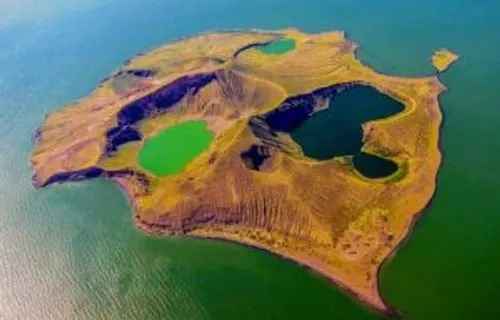
The Jade Sea
Picture a vast lake the color of jade, lying in the middle of a black volcanic desert. There are no resorts on its shores and no crowds. The wind blows almost every day, crocodiles slide along the sandy banks, and the ground beneath your boots is scattered with clues to where our own species came from. This is Lake Turkana, in the far north of Kenya, and it is one of the most extraordinary places in Africa.
Where is Lake Turkana? Lake Turkana lies in a remote corner of northern Kenya close to the border with Ethiopia. It sits inside the Great Rift Valley where the land has been slowly pulling apart for millions of years. That stretching has left behind volcanoes, lava fields, deep basins and, in this case, a huge lake. The lake is about 290 kilometers long and covers around 6,400 square kilometers, which makes it far bigger than most people expect. It is the largest permanent desert lake in the world, and the largest alkaline lake on earth.
Why is it green? Most of Lake Turkana's water comes from the Omo River, which begins in the highlands of Ethiopia and travels a long way south before it empties into the lake. Lake Turkana has no outlet, so the only way water leaves is by evaporating in the fierce desert heat. Over time, the minerals and salts are left behind, which makes the water alkaline. Tiny algae thrive in these conditions, and they tint the surface a soft, shifting green. Depending on the light and the wind, the lake can look jade, turquoise, grey or gold, which is why early explorers called it the Jade Sea.
Where human story is written on the ground The Turkana Basin, is one of the richest places on earth for finding the fossils of our earliest ancestors. Part of the reason is geology: the same volcanic activity and river sediments that shaped the landscape also buried bones quickly and preserved them for millions of years. Today, wind and rain slowly uncover them again. Over decades, teams of scientists have found thousands of fossils here.
The most famous find is Turkana Boy. In 1984, the Kenyan fossil hunter Kamoya Kimeu spotted a small fragment of skull on the western side of the lake. They uncovered an almost complete skeleton of a young Homo erectus, about 1.6 million years old. It remains one of the most complete early human skeletons ever discovered.
| Site | Where | What was found |
| Koobi Fora | East shore | Thousands of fossils, including a Homo erectus skull about 1.75 million years old |
| Nariokotome | West shore | Turkana Boy, a 1.6-million-year-old Homo erectus skeleton |
| Lomekwi | West shore | Stone tools about 3.3 million years old, and a 3.5-million-year-old skull named Kenyanthropus platyops |
| Ileret | East of the lake | Footprints about 1.5 million years old |
| Sibiloi National Park | East shore | A petrified forest, with trees turned to stone |
Life on and around the lake .
The lake is home to one of the largest populations of Nile crocodiles in Africa, along with hippos and huge numbers of fish. It also lies on a major route for migratory birds, and many species travel here from Europe and Asia during the northern winter, so flamingos, pelicans and many other water birds can be seen along the shore.
On the southern shore, the small town of Loiyangalani feels like a surprise. Palm trees and freshwater springs create a green oasis against the dramatic backdrop of Mount Kulal. And not far away, in one of the windiest parts of Kenya, you will see something unexpected in the desert: 365 wind turbines, part of the Lake Turkana Wind Power project, which began supplying electricity to Kenya's national grid in 2018.
The people of the Lake
The Turkana people are the largest community in the region. Traditionally pastoralists who herd livestock, many also fish the lake. Turkana men often carry a small wooden stool called an ekicholong, which doubles as a headrest, and Turkana women are known for their layered, colorful beaded necklaces. The El Molo are one of Kenya's smallest communities and have traditionally lived by fishing, once using rafts made from the trunks of doum palms. The Samburu, Rendille, Gabbra and Dassanech also live in the wider region, each with their own language, traditions and way of life. Many visitors say meeting these communities is the highlight of the trip
Planning your journey
Lake Turkana is remote, so a little planning goes a long way. Most travellers fly from Nairobi to the town of Lodwar, which takes about an hour and a half, and then continue overland or by light aircraft to a camp on the lake. It is also possible to drive from Nairobi via Maralal or Marsabit, crossing the stark Chalbi Desert on the way, but the roads are long and rough, so you will need a 4x4 and an experienced guide.
| Planning | What to know |
| Best time | June to October and January to February are the most comfortable. It is hot all year, with daytime temperatures often in the 30s °C |
| What to pack | Light cotton layers, a wide-brimmed hat, sunscreen, closed shoes and a windproof jacket for boat rides |
| Safety | Because of crocodiles, hippos and strong winds, swimming in the lake is not advised, and boat trips should only be done with local guides |
| Who it suits | Adventurous travellers, photographers, history and science lovers, and repeat visitors who want something different from a classic safari |
Why Turkana?
You do not come to Lake Turkana to tick off the Big Five. You come for the scale of the landscape, the silence, the people and the feeling of standing at the very beginning of the human story. It is a journey few travellers make, which is exactly why those who do rarely forget it.
Come for the fossils, and stay for the sunrise. Ready to go beyond the usual safari route? Contact us at Yulle Adventures for itineraries and quotations.